


Aurora Time Machine
AURORAS AS TIME MACHINES: The
fall of 1770 was not a good time for Capt. James Cook and the
crew of the HMS Endeavour. One year earlier, they successfully
observed the transit of Venus from Tahiti. Many aboard would rue
leaving that paradise. After a violent stop in New Zealand, Endeavour
struck Australia's Great Barrier Reef, tearing a massive hole in
her hull and beaching the vessel for 7 weeks for repairs. By the
time the ship was underway again, many of the crew were suffering
from tropical diseases, malnutrition, and exhaustion.
That's when the geomagnetic storm struck.
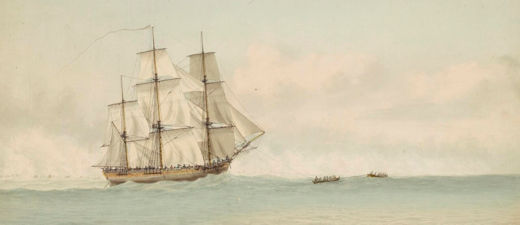
Endeavour was sailing near Timor Island (latitude -9.9o) on Sept. 16, 1770, when red auroras appeared in the night sky. The expedition's naturalist Joseph A. Banks and his assistant Sydney Parkinson both noted the event in their logs, although they were unsure what they had seen. The idea that auroras could spread to within 10 degrees of the equator seemed outlandish.
Yet auroras they were. A 2017 study led by Hisashi Hayakawa established that Cook's auroras were part of an extreme 9-day display across China, Japan, and Southeast Asia. Some of the lights were "as bright as a full Moon."
Clearly, the "Cook Event" was a big deal. But how big? Researchers have long wondered. Magnetometers were only invented in the 19th century, so there are no scientific measurements of geomagnetic activity before then. Rating old storms has been a matter of guesswork.
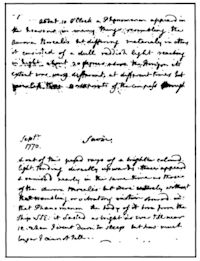 Right: Joseph Banks' 1770 aurora log entry.
A study published in the April 2025 edition of Space Weather may have solved this problem by turning auroras into time machines.
In their paper,
Jeffrey Love of the US Geological Survey and colleagues analyzed 54
geomagnetic storms from 1859 to 2005, using both magnetometer data and
overhead aurora sightings. By correlating the two, they developed a
statistical model that lets researchers estimate the strength of
historical storms based on eyewitness accounts—no magnetometer required.
One of the key findings of their study is that Cook's storm was (within the margin of error) the same size as the famous Carrington Event of 1859. They also found a very big storm just a few days before the Carrington Event. On August 28, 1859, there were no magnetometer data available because it was Sunday, a day off for observatory staff. However, auroras were reported overhead in Havana, Cuba. Love's model pegged that storm at ~two-thirds of the Carrington Event, making it one of the biggest geomagnetic storms on record.
The good news for Cook and his crew: They weren't using modern technology like radio or GPS, which might have failed. Cook had no trouble navigating the magnetic storm. If it happened again today, we might not be so lucky.
Read the original research here.
whew - yellowstone
Striking new images reveal the hidden magma network beneath Yellowstone
New seismic imaging reveals Yellowstone’s magma chamber sits 3.8 km below the surface and isn’t at risk of erupting anytime soon.

A new study has finally provided a detailed picture of what lies just below Yellowstone’s surface. (CREDIT: iStock.com / kwiktor)
Beneath Yellowstone National Park lies something extraordinary—a giant underground chamber filled with molten rock, trapped gases, and intense heat. For years, scientists have known about this volcanic reservoir. But only recently have they been able to see its upper boundary with real clarity.
A new study has finally provided a detailed picture of what lies just below the surface, and it’s changing how researchers understand the risks and mysteries hidden beneath this famous national park.
Thanks to the work of seismologists from the University of Utah and the University of New Mexico, the veil over Yellowstone’s volcanic heart is lifting. Their findings were published in the prestigious journal Nature, and the data is both eye-opening and reassuring.
A Sharper Look Beneath the Surface
The new research used an innovative approach. Rather than waiting for natural earthquakes, the team created their own seismic waves. Using a Vibroseis truck—a machine normally used in oil and gas exploration—they shook the ground at 110 different locations in Yellowstone. At each site, the machine delivered 20 powerful vibrations, each lasting about 40 seconds.
Nearby, 650 portable seismometers were placed along park roads at intervals of 100 to 150 meters. These small devices recorded how the ground moved. By studying the data, scientists built detailed two-dimensional images of the Earth’s subsurface—similar to a CT scan of the human body, but for rocks and magma.
“In a sense, we’re causing our own earthquakes, and we record all that data on the seismometers,” explained Jamie Farrell, a research associate professor at the University of Utah and chief seismologist at the Yellowstone Volcano Observatory.
This method allowed scientists to locate the top of Yellowstone’s magma chamber. They found it sits about 3.8 kilometers (12,500 feet) below the surface. That’s a lot closer than many people might expect. Even more surprising is how sharply defined the top of the chamber is compared to the surrounding rock layers.
“The depth of 3.8 kilometers is important,” said Farrell. “We know what pressures are going to be and how bubbles are going to come out of the magma. One thing that makes these eruptions so devastating is that if gases are trapped, they become very explosive as they decompress.”

War is a Racket (1935)
By Smedley D. Butler
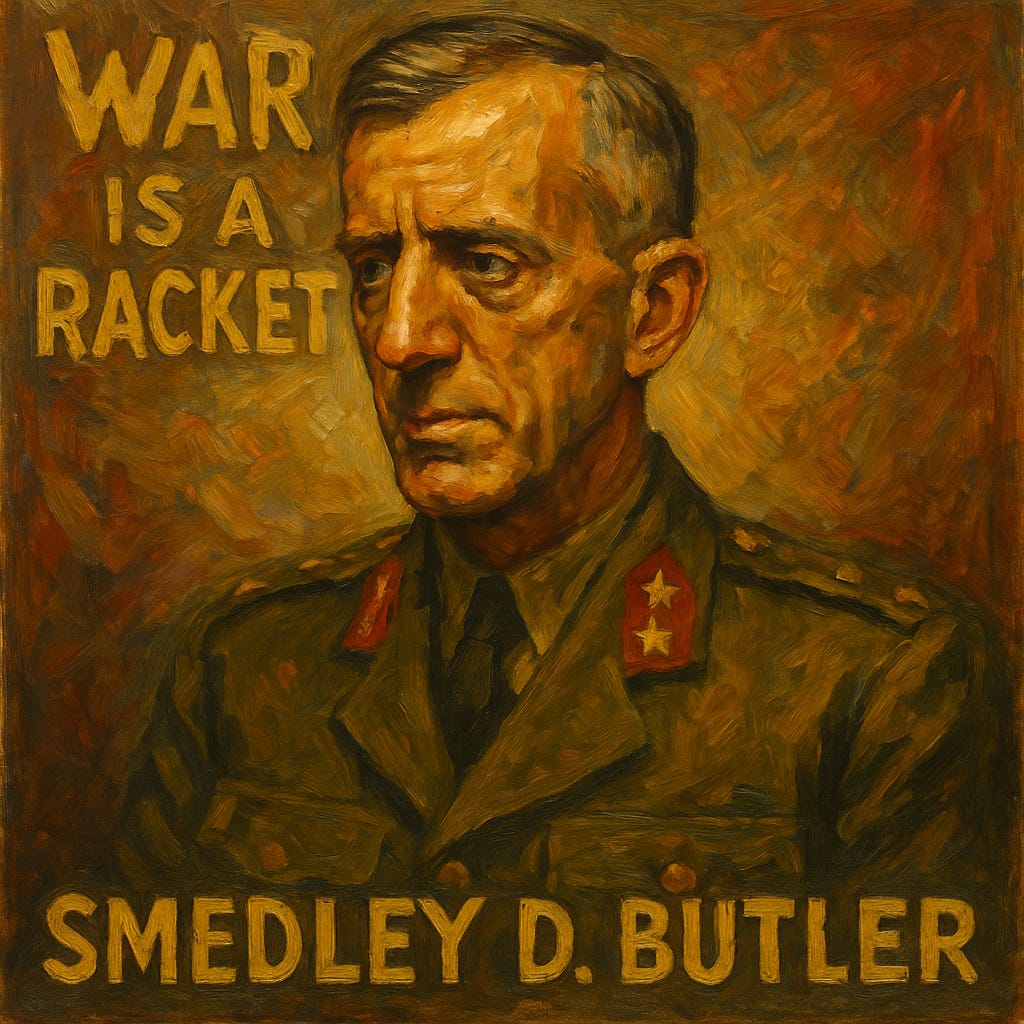
In this current moment where the specter of a new war with Iran looms, the searing critique of Major General Smedley D. Butler in War Is a Racket resonates with chilling relevance. Published in 1935, Butler’s work exposes war as a meticulously orchestrated "racket," where a small, organised minority—those "creatures that run the show from the shadows"—reap colossal profits while the masses bear the costs in blood, grief, and economic ruin. Drawing from his decades as a decorated Marine, Butler unveils the machinery of war profiteering, noting, “Out of war a few people make huge fortunes,” while soldiers and civilians shoulder “newly placed gravestones” and “shattered minds.” His revelations find echoes in Understanding Bankers’ Wars, which traces how financial elites, from the Napoleonic era to World War I, engineered conflicts to amass wealth, manipulating nations into debt and destruction. Yet, Butler’s indictment is not merely historical; it serves as a call to question the single minded ambition of those who, as Neema Parvini highlights are the "organised minority" in The Populist Delusion (2022), wield disproportionate power to shape global destinies.
Butler’s legacy extends beyond his written words to his courageous stand against a hidden chapter of American history: the 1933 Business Plot. As detailed in The Business Plot, a cabal of wealthy industrialists and bankers sought to overthrow President Franklin D. Roosevelt and install a fascist dictatorship, a scheme thwarted by Butler’s whistleblowing. This critical event, suppressed for decades, reveals the audacity of those “creatures” who, nearly a century ago, aimed to go “full fascist” in America, underscoring their persistent ambition to control from the shadows. Butler’s role in exposing this coup, referenced in You Knew What You Signed Up For during an interview with Chase Spears, highlights his moral clarity in confronting elite machinations.
Butler’s grim accounting—“mangled bodies,” “broken hearts and homes,” and “back-breaking taxation for generations”—lays bare the asymmetry between the few who profit and the many who pay. His proposed solutions, such as conscripting capital alongside soldiers and limiting military reach to defensive purposes, challenge the status quo with radical pragmatism. Yet, as Understanding Bankers’ Wars suggests, the entrenched power of financial elites often subverts such reforms, perpetuating cycles of conflict. This introduction frames Butler’s War Is a Racket as a timeless exposé, urging readers to interrogate the motives behind modern wars and the organised minority orchestrating them, lest history’s lessons remain unheeded.
With thanks to Smedley D. Butler1.
War is a Racket: Original 1935 Edition: Butler, Smedley D.
All Wars are Banker's Wars - remember
reduced to rubble
Iran Shatters Israel’s Illusion of Invincibility
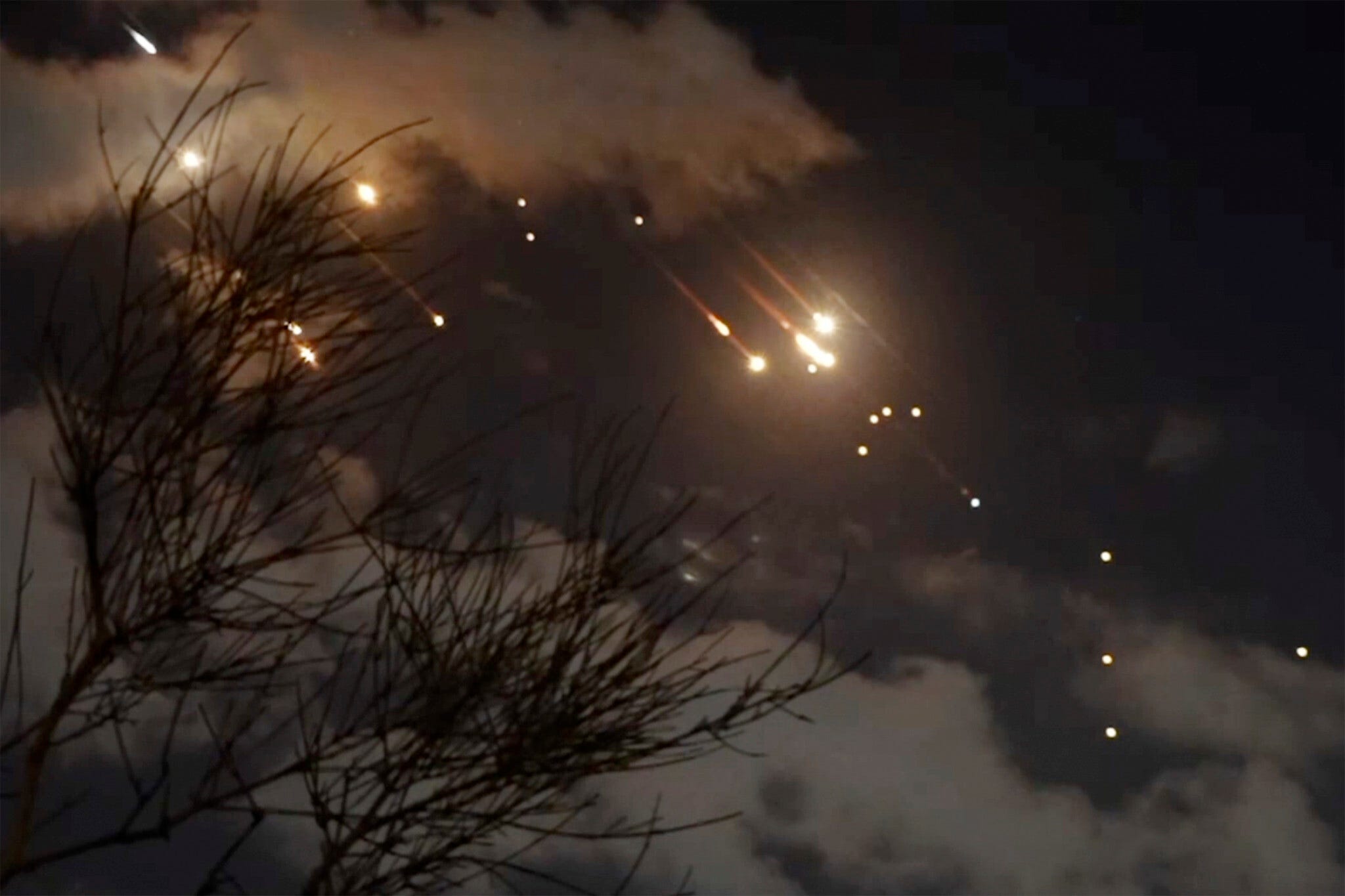
The myth of Israeli military invulnerability lies in rubble.
What’s proven to be a historic and humiliating turn for Israel’s Zionist regime, Iran has dealt a blow not just to Israel’s infrastructure — but to the very foundation of its psychological warfare. The illusion of supremacy and impunity has collapsed in real time.
Israel’s cyber-assisted strike on Iranian military and nuclear infrastructure was supposed to be a game-changer. Executed in tandem with a sophisticated cyberattack that disabled Iran’s air defence systems for approximately eight hours, the operation was designed to disorient, disrupt, and dominate. It failed. Spectacularly.
Within ten hours, Iranian technicians restored their systems. By hour twelve, the first wave of Iranian ballistic missiles rained down across Israel — targeting military command hubs, critical intelligence sites, and, notably, the Weizmann Institute of Science in Rehovot.
The Iron Dome — long held up as a marvel of modern defence — was useless. US-deployed THAAD systems guarding the IDF’s military headquarters also failed under the barrage. This wasn’t just an act of retaliation. It was an unveiling. But the world already knew the Iron Dome was a just a plastic bubble. Iran demonstrated that last year with its responses to the attacks and assassination of one of it’s top IRGC generals and killing of staff at its consulate in Damascus with its retaliatory strikes of Operations True Promise 1 and 2. Operation True Promise 3 is as Iran said would be more devastating and frighteningly destructive.
Israel’s model of warfare has always been pre-emptive, provocative, and deeply reliant on its assumption of strategic superiority.
From assassinating Iranian scientists to bombing airfields in Syria and flattening apartment blocks in Gaza, Israel’s actions have consistently escaped consequences. It fights without fear of retaliation, armed with American munitions and diplomatic impunity. Its strategy depends on hitting others — but never being hit.
Israel’s doctrine of one-sided warfare is now bankrupt. The retaliatory strikes by Iran did more than damage Israeli infrastructure — they shattered the myth that Israel is untouchable. What we are witnessing is not just a military failure, but an existential crisis for the Zionist regime. Its greatest weapon — fear — no longer works.
It's evident Iran’s restraint has brought no peace. Instead, it has emboldened Israel to take ever more dangerous steps, convinced of its own invulnerability. The message is clear: non-nuclear nations have no real sovereignty in the eyes of the West or its proxies.
In this reality, Iran has only one path to ensure its security: nuclear deterrence. Not as a weapon of aggression — but as the sole viable shield against perpetual threats from a nuclear-armed neighbour with a record of regional destruction.
Israel's refusal to sign the Non-Proliferation Treaty while stockpiling nuclear warheads under US protection is a provocation. Its demand that Iran remain non-nuclear, while it carries out military strikes across sovereign borders, is not just hypocritical — it’s suicidal policy by design. Iran’s nuclear pursuit is no longer about prestige. It is about survival.
The US is no longer the force it once was. As Washington scrambles to maintain control in Ukraine, it has now begun diverting munitions and air defence systems intended for Kyiv to Israel — highlighting an overstretched empire trying to prop up too many proxies at once.
Russia, meanwhile, has made clear that it stands behind Iran through the January 17 Strategic Partnership Agreement. Article 3 of the pact ensures that neither party will assist an aggressor. Article 5 lays the groundwork for expanded military cooperation. That is not theory — that is strategy in motion.
Iran’s alliances with Russia, China, and a constellation of anti-imperial actors in the Global South has repositioned it from isolated pariah to pivotal power. In contrast, Israel’s reliance on American protection and European silence is growing brittle.
This war is not just about missiles. It is about whose order defines the Middle East — and who has the courage to defy it.
For the first time in its modern history, Israel is being hit in a way it cannot hide. Social media is flooded with footage of Iranian missiles striking with impunity. The “startup nation” now finds itself scrambling to explain why its expensive defence systems failed, why its most protected military sites were breached, and why its population is suddenly experiencing the fear it has inflicted on others for decades.
The strategic tide is turning. What we’re seeing is not just retaliation. It’s the beginning of recalibration. A region exhausted by Israeli impunity has finally seen that the Zionist regime bleeds.
And that changes everything.
No Link To Modern Humans?
6,000-Year-Old Skeletons Have Distinctive DNA With No Link To Modern Humans
- Ancient human remains found in Colombia reveal a previously unknown population lineage.
- The skeletons, ranging from 6,000 to 500 years old, do not match any known local indigenous groups.
- Genetic analysis of 21 individuals was published in Science Advances, highlighting unique ancestry.
In a major archaeological breakthrough, scientists revealed that ancient human remains, unearthed in the Bogota Altiplano in central Colombia, do not match any indigenous human population in the region. The skeletons are 6,000 to 500 years old, and the study revealed that some of the individuals belonged to a previously unknown population. A team of researchers studied the genetic data of 21 individuals and published findings in the journal Science Advances in May.
Earlier studies have revealed that two lineages existed - northern Native American and southern Native American. It developed when people started to move south after first arriving on the continent from Siberia. The southern Native American is further divided into at least three sub-lineages.
However, scientists have yet to find the exact time and other details when the first people would have moved from Central America to South America.
Also read | Scientists Observe Light Of "Cosmic Dawn" With Telescope On Earth For The First Time Ever
"We show that the hunter-gatherer population from the Altiplano dated to around 6000 yr B.P. lack the genetic ancestry related to the Clovis-associated Anzick-1 genome and to ancient California Channel Island individuals," the study noted.
"The analysed Preceramic individuals from Colombia do not share distinct affinity with any ancient or modern-day population from Central and South America studied to date," the study added.
"Colombia_Checua_6000BP can thus be modeled as a previously undescribed distinct lineage deriving from the radiation event that gave rise to multiple populations across South America during its initial settlement," it mentioned.
The study author, Andrea Casas Vargas, a researcher at the Universidad Nacional de Colombia, told CNN on Wednesday (June 11) that the research team was "very surprised" with the findings.
"We did not expect to find a lineage that had not been reported in other populations," Vargas added.
Kim-Louise Krettek, lead author and a PhD student at the Senckenberg Center for Human Evolution in Germany, said, as quoted by Express UK, that this area is key to understanding "how the Americas were populated".
"It was the land bridge between North and South America and the meeting point of three major cultural regions: Mesoamerica, Amazonia, and the Andes." Krettek added.
The study is very important, Vargas said, adding that it is the first to sequence complete genomes in ancient samples from Colombia.
Vargas said that the results raise questions "as to where they came from and why they disappeared.
"We are not certain what happened at that time that caused their disappearance, whether it was due to environmental changes, or if they were replaced by other population groups," she said, further adding that more research will provide some answers, hopefully.


oh yeah...


-
Dean Henderson and Jeff discuss current events and take a whack at the global oligarchy. Check out more info from Jeff Rense at Alt News ...
-
Burt Bacharach, Music artist Co-author (with lyricist Hal David) of an extensive string of hits in the '60s, Burt Bacharach is one of...


