1. Basically, you can’t leave the house for any reason, but if you have to, then you can...
2. Masks are useless, but maybe you have to wear one. It can save you - unless it is useless. But, it is mandatory as well...
3. Stores are closed, except those that remain open...
4.
You should not go to hospitals unless you have to go there. You should
only go there in case of emergency, provided you are not sick...
5. This virus is deadly - but not too scary, except that sometimes it leads to a global disaster...
6. Gloves won’t help, but they might help...
7. Everyone needs to stay HOME, unless it’s important to go somewhere...
8. There are no shortages of groceries in the supermarkets, but there are many things missing when you do go...
9. The virus has no effect on children, except for those it affects...
10. Animals are not affected, but there is still a cat that tested positive in Belgium...
11.
You will have many symptoms when you are sick, but you can also get
sick without symptoms, have symptoms without being sick, or be
contagious without having symptoms... Just punt...
12.
In order not to get sick, you have to eat well and exercise. Eat
whatever you have on hand, unless you have no food on hand...
13. It’s better to get some fresh air. Don’t go to parks or walk anywhere. Maybe sit down to breathe...
14. You can’t go into retirement homes, but you have to take care of the elderly who live there...
15. If you are sick, you can’t go out. You can go to the pharmacy, but only if you are not well...
16. You can get restaurant food delivered to the house, but you have to have your store groceries decontaminated...
17. Every disturbing article or disturbing interview starts with "I don’t want to trigger panic, but…”
18. You can’t visit your mother or grandmother, but you can take a taxi and meet an older taxi driver...
19. You can walk with a friend, but not with your family. Especially if they live under the same roof...
20. You are safe if you maintain the appropriate social distance. But you can’t go anywhere...
21. The virus remains active on different surfaces for two hours. But not necessarily...
22. The virus lives in the air. Or no, or yes, or maybe. Especially in a closed room...
23.
We would count the number of deaths, but we don’t know how many people
are infected... But that’s what they will die of anyway…
24. We should stay locked up until the virus disappears. But we might get locked up after that...
This
work confirms the presence of electromagnetic radiation within
bacterial communities, which is a key requirement to demonstrate
electromagnetic signalling among bacterial cells.
The
insight could lead to breakthroughs in demystifying how cells
communicate as well as the advancement of important technologies in
biology and communication systems.
But,
much more importantly, this is a very firm and strong warning to
mankind to stop playing with biology here on Earth – we may have to very
profoundly regret it.
My
personal comment to this is: just imagine what our man-made
high-frequency signals, used by cell phones, wireless smart meters, WiFi
systems, wireless baby alarms, DECT phones, Internet of Things (IoT),
Internet of Bodies (IoB), and many more gadgets/installations/systems,
delivered at colossal power levels compared to the natural ones, may do
to these intricate communicative mechanisms! The above may, in addition –
if replicated by independent scientists in further controlled studies –
explain the observed occurrence of antibiotic resistance after
exposures of common bacteria, like Listeria monocytogenes and
Escherichia coli, to the radiation of 2G mobile telephony or WiFi-router
fields (cf. above; see also Johansson 2017).
Soil
bacteria are also affected by radiation from mobile phone towers
It
must also be noted that Sharma Antim Bala and coworkers (2018) have
demonstrated the impact of the radiations transmitted by mobile tower
base stations on microbial diversity in soil and antibiotic resistance
patterns. Soil samples were taken from near four different base stations
located in Dausa City, India, while control samples were taken far from
any base stations.
Please,
find enclosed my most recent paper about the impact of artificial
electromagnetic fields from cell phone systems, WiFi, high-frequency
light bulbs, wireless smart meters, baby alarms, smart cities, the
Internet of Things and the Internet of Bodies, 5G, and much more, on
bacteria - including on our bacteria - resulting in antibiotic resistance.
I
strongly feel this is the most important contribution of mine so far.
If people don't listen to this message, then I honestly don't know what
to do. --- If you don't use it as a giant mental sledgehammer, then I
honestly don't know what to do. --- If I honestly don't know what to do
... maybe then it is 'game over'?
Johansson O, "Stop! In the Name of Life!”, Newsvoice.se 9/1, 2025
They
serve it to us in the name of climate, progress, SMART cities, because
everything must be connected, modern medicine, fighting cancer - IoT,
nanotechnology, 13 Agenda 2030 goals, building a great city in the
desert, c40 cities, environmental, sustainable...
Apparently, this is a toxic and deadly technology, concentrated in the hands of a small group of people.
Studies and common sense indicate that it will lead to extinction.
No one asks our opinion when they put up 5G towers or build 15-minute ghettos.
They
are hiding their plans to introduce CBDC, which is based on 5G and
graphene nodes in every body, referred to as “vaccines”.
Shrouded in mystery, presented as an achievement of civilization.
And those who ask questions or protest are ridiculed and murdered.
Professor
Olle Johansson writes about the doom that this EMF technology can
bring. Add to that the toxicity of nanotechnology, which in the name of
“climate” is to be - and is being - added to everything. It will not
only kill humanity, but it will also destroy all life on this planet.
Let's put an end to this madness and stop the sect that is pushing this...
COAST TO COAST RADIO: In the second half, Stanley Milford Jr.
discussed how the paranormal became part of his job when he joined the
Navajo Rangers — a law enforcement branch of the Navajo Nation who are
police officers, conservationists, and historians. He recounted how he
was thrust into the role of investigating supernatural phenomena during a
case where an elderly woman claimed a Bigfoot stole her laundry. "You
may not understand these cases... but people are asking for help," he
explained.
Milford spoke candidly about his upbringing that straddled two
cultures: Navajo and Cherokee. "It was kind of a clash of two worlds,"
he noted. His experiences on the reservation informed his understanding
of Navajo traditions, including the serious implications of witchcraft.
He recalled a chilling encounter with a skinwalker, a shape-shifting
entity. "At that point, there was like ice water running through my
veins," he shared. "Shape-shifting... is a part of witchcraft, black
witchcraft," he said.
Milford also outlined the daunting task of enforcing the law with
only eight officers available across the 27,000-square-mile Navajo
reservation. "You didn't have somebody standing there holding your
hand," he recounted, before describing a harrowing manhunt for fugitives
who killed a police officer. "I spent the next month out there crawling
in the river bottoms... learning what it meant to be a tactical
operator," he recalled. Milford then went on to detail a bizarre
investigation involving the mysterious deaths of 26 sheep. "All of these
sheep were dead, but you didn't see the telltale evidence of a
predatory kill," he noted, describing how the sheep were precisely slit
open and drained of all blood. A veterinarian on the scene was equally
baffled, leading Milford to connect the case to cattle mutilations seen
elsewhere.
Spend $35 and get FREE shipping at HarperCollins.com
A
Navajo Ranger’s chilling and clear-eyed memoir of his investigations
into bizarre cases of the paranormal and unexplained over the course of
his illustrious career serving the Navajo Nation.
Stanley
Milford, Jr., was raised with the inherent belief that the supernatural
regularly touches our lives. Growing up between multiple worlds and
cultures, as a Native American with parents and family of both Navajo
and Cherokee descent, he was raised to respect his roots with a firm
upbringing in traditions from both tribes.
That would serve him
well when he joined the fabled Navajo Rangers, who are equal parts
police officers, archeological conservationists, and historians,
responsible for overseeing the massive 27,000-square-mile Navajo Nation.
When Milford first became a ranger, he handled mundane, everyday cases
such as cattle inspections and domestic disputes, but that quickly gave
way to utterly bizarre and shockingly frequent cases of mysterious
livestock mutilations, skinwalker and cryptid sightings, unidentified
aerial phenomena, and malicious hauntings.
In The Paranormal Ranger,
Milford recounts all the stories from the logical, factual, and serious
perspective of a law enforcement officer. Far from the tinfoil hat and
conspiracy crowd, Milford’s Native American worldview and investigative
training provide a chilling, realistic perspective on what logic
dictates should not be possible.
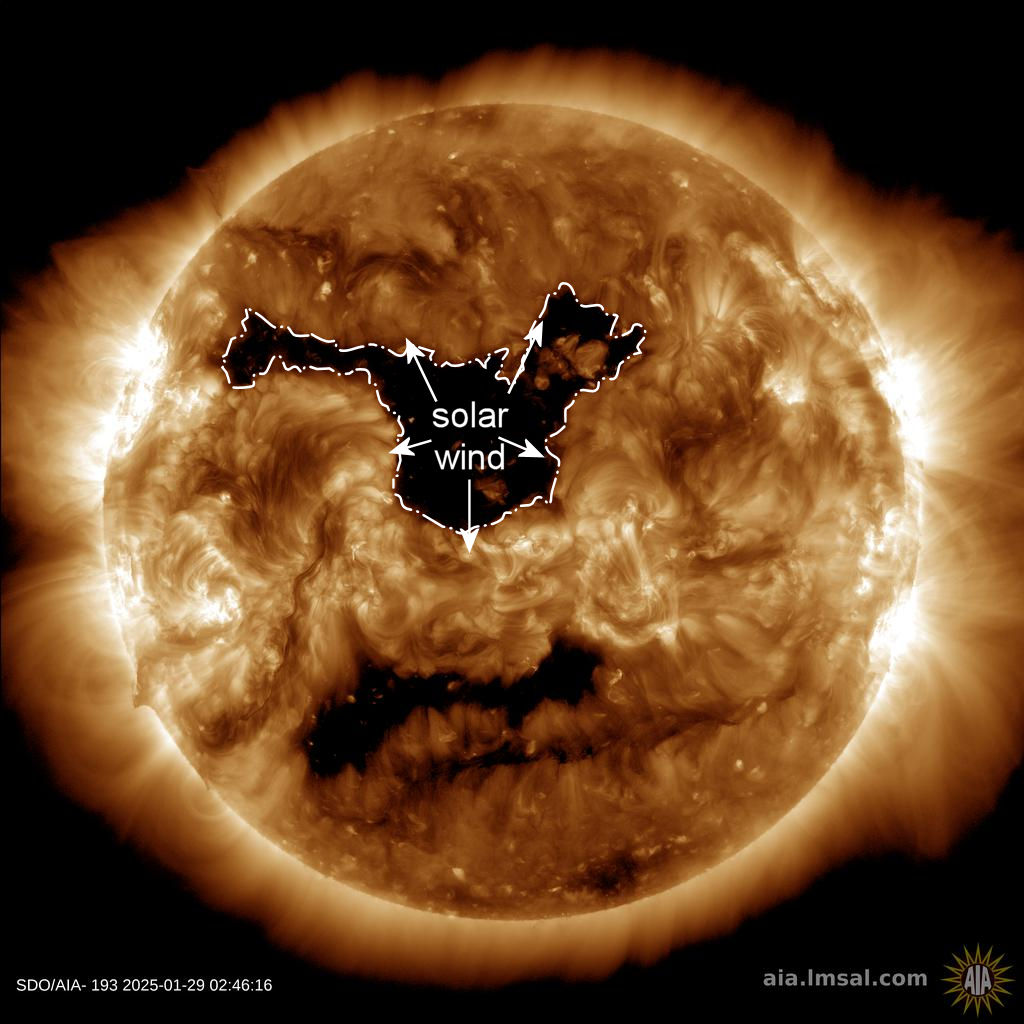
A HOLE IN THE SUN'S ATMOSPHERE: A large hole in the sun's atmosphere is directly facing Earth and blowing a stream of solar wind in our direction. Estimated time of arrival: Feb. 1st. Minor G1-class geomagnetic storms are possible when the gaseous material reaches Earth.
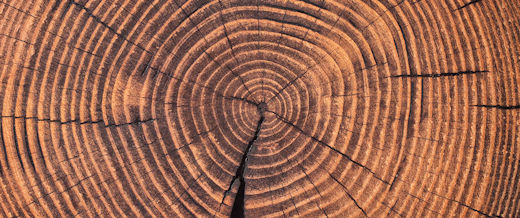
A WARNING FROM THE TREES:How
bad can a solar storm be? Just ask a tree. Unlike human records, which
go back hundreds of years, trees can remember solar storms for
millennia.
Nagoya University doctoral student Fusa
Miyake made the discovery in 2012 while studying rings in the stump of a
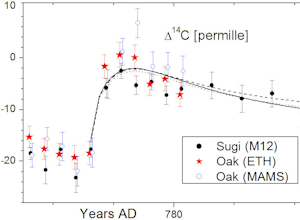
1900-year-old Japanese cedar. One ring, in particular, drew her
attention. Grown in the year 774–75 AD, it contained a 12% jump in
carbon-14 (14C), an isotope created by cosmic radiation. The surge was
20 times greater than ordinary fluctuations in cosmic rays. Other teams
confirmed the spike in wood from Germany, Russia, the United States,
Finland, and New Zealand. Whatever happened, trees all over the world
experienced it.
Most researchers think it was a solar storm—an extraordinary one. Often, we point to the Carrington Event of 1859
as the worst-case scenario for solar storms. The 774-75 AD storm was
at least 10 times stronger; if it happened today, it would floor modern
technology. Since Miyake's initial discovery, she and others have
confirmed four more examples (7176 BC, 5259 BC, 664-663 BC, 993 AD).
Researchers call them "Miyake Events."
It's not clear that all Miyake Events are
caused by the sun. Supernova explosions and gamma-ray bursts also
produce carbon spikes. However, the evidence tilts toward solar storms.
For each of the confirmed Miyake Events, researchers have found
matching spikes of 10Be and/or 36Cl in ice cores. These isotopes are
known to trace strong solar activity. Moreover, the 774-75 AD Miyake
Event had eyewitnesses; historical reports of auroras in China and England suggest the sun was extremely active around that time.
Miyake Events have placed
dendrochronologists (scientists who study tree rings) in the center of
space weather research. After Miyake’s initial discovery in 2012, the
international tree ring community began working together to look for
evidence of solar superstorms. Their collaboration is called "the
COSMIC initiative." COSMIC results published in a 2018 edition of Nature confirm that Miyake Events in 774-75 AD and 993 AD were indeed global. Trees on five continents recorded carbon spikes.
"There could be additional Miyake Events throughout the Holocene"
says Irina Panyushkina, a member of the COSMIC initiative from the
University of Arizona's Laboratory for Tree-Ring Research. "Finding them
will be a slow and systematic process."
Above: A global map of COSMIC tree ring and ice core measurements [more]
"An important new source for annual 14C measurements are floating tree-ring records
from Europe and the Great Lakes," says Panyushkina. "These are very old
rings that could potentially capture 14C spikes as far back as 15,000
years. Eventually, I believe we will have a complete record of Miyake
Events throughout that period."
Four more candidates for Miyake Events have recently been identified (12,350 BC, 5410 BC, 1052 C, and 1279 C). The candidate in 12,350 BC,
identified from tree rings the French Alps, may be more than twice the
size of any other Miyake Event. Confirmation requires checking trees on
many continents and finding matching spikes of 10Be and 36Cl in ice
cores.
A complete survey of Miyake Events could
tell us how often solar superstorms occur and how much peril the sun
presents to a technological society. Stay tuned for updates from the
trees.
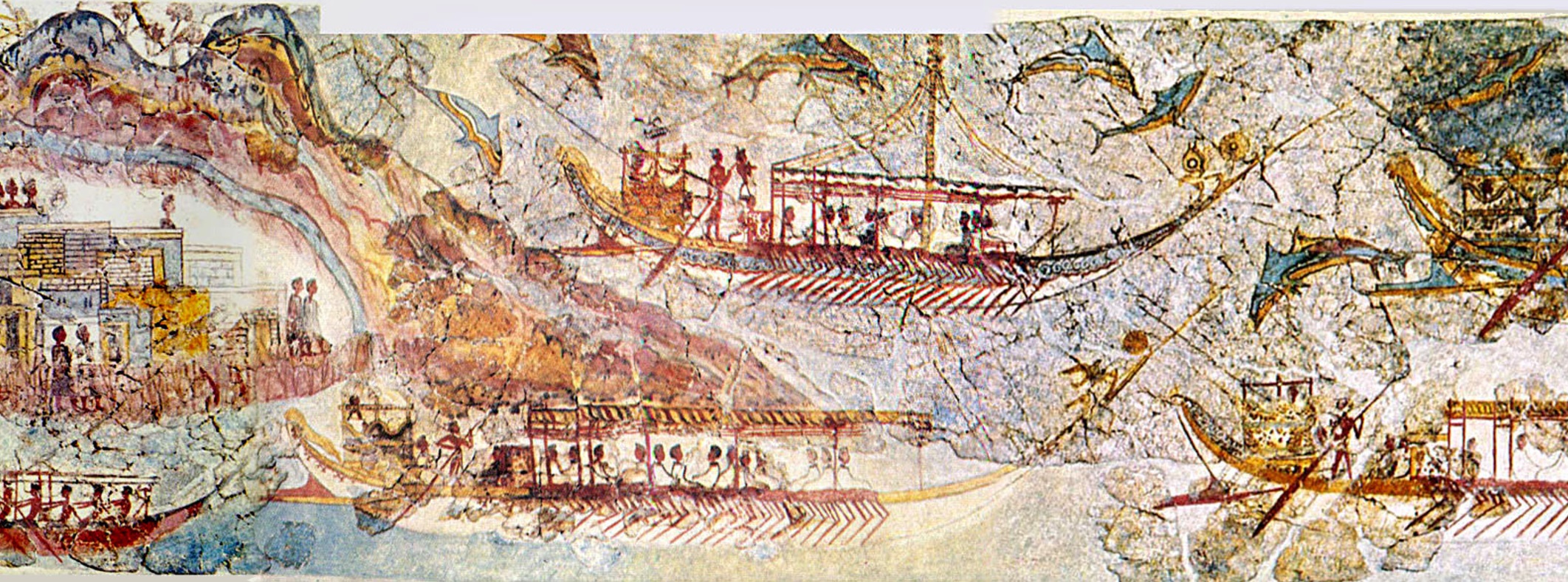
Bronze Age depiction of a procession of Minoan ships from Akrotiri, Thera. Credit: Public domain
In Plato’s account of Atlantis, found in both Timaeus and Critias,
the legendary island civilization supposedly fought a war against the
Greeks. This is a vital part of the account, for it is the whole reason
why Plato included it in these dialogues.
However, is there any evidence that this legendary war between Atlantis and the Greeks really happened?
Plato’s account of the war against Atlantis
In Timaeus, written around 360 BCE, Socrates expresses his wish to hear an account about Athens in action. Critias responds that he knows of such an account. He then goes on to tell Socrates the story of Atlantis.
According to Critias, who claims that the story ultimately originated
from the Egyptians, Atlantis was a rich and powerful island-based naval
civilization from the distant past. It dominated a large portion of the Mediterranean. It even attempted to subdue Egypt and Greece.
Critias explains to Socrates that Athens took the lead among those
fighting against Atlantis. After everyone else had fallen to Atlantis,
the Greeks were finally able to defeat it, thus bringing an end to their
reign of terror.
A memory of the Sea Peoples?
Some researchers have attempted to connect this account with the
historical activities of the Sea Peoples. The Sea Peoples were a group
of nations mentioned in Egyptian records as a cause of significant
trouble between the years 1270 and 1175 BCE. Although there is still
debate regarding the identity of each people mentioned, scholars
generally agree that at least some of them were European nations of the
Mediterranean coastlands.
Given that Egyptian records tell of a large war
in the early 12th century BCE against these peoples, it might be
tempting to connect this event to the legendary war against Atlantis
since the Egyptians were involved in that war according to Plato’s
dialogues.
However, there are two major problems with this interpretation.
Firstly, Plato’s account presents the Greeks as defeating Atlantis after
everyone else had been defeated. In contrast, the Egyptians were the
ones who defeated the Sea Peoples.
An even bigger problem is that one of the Sea Peoples attacking Egypt were the Denyen. The name appears to be the Egyptian form of ‘Danaans,’ one of the ancient Greek names for themselves. This would put the Greeks on the same side
as Atlantis in this war against Egypt, which is the exact opposite of
what Plato described. Therefore, the war against the Sea Peoples does
not match the war against Atlantis.
A more likely origin
On
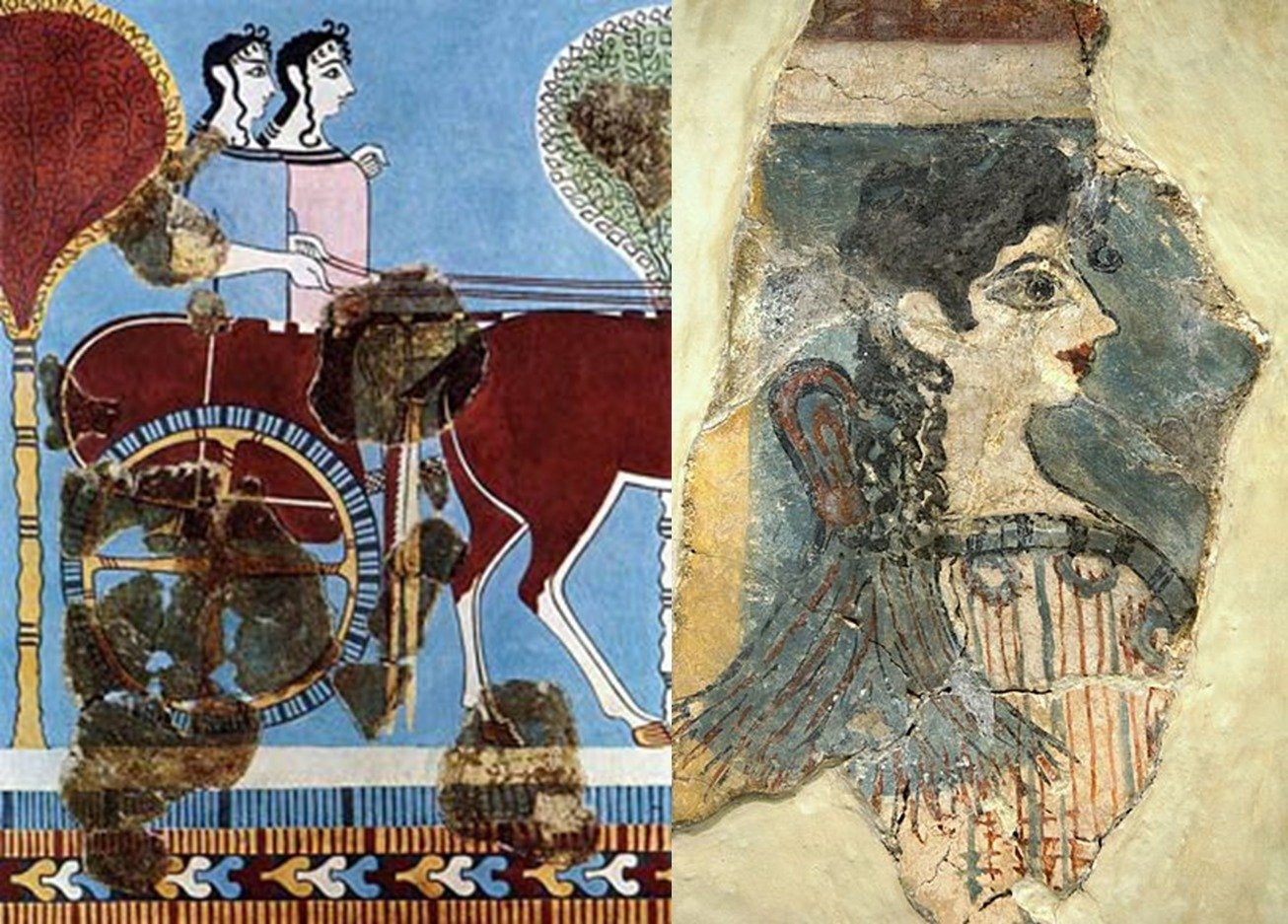
the left, a Mycenaean fresco of two women on a chariot, and, on the
right, a Minoan fresco of a woman. Credit: Public Domain / Heraklion
Archaeological Museum / CC BY-SA 4.0 / Wikimedia Commons
It is more likely that the war between Atlantis and Greece can be
traced back to an even older historical event. Rather than connecting
the tale of Atlantis with the Sea Peoples, the Encyclopedia Britannica suggests that this legend may originate with the Minoan civilization. This civilization thrived in the Bronze Age.
Like Plato’s Atlantis, the Minoans were a rich and powerful
island-based naval civilization. They were situated just before the Gulf
of Laconia, one of the places known as the Pillars of Heracles in antiquity. The Minoans also had several colonies on the opposite continent in Asia Minor, matching what Plato wrote. Various other aspects of their civilization also match what Plato wrote.
Although we do not have detailed written records of Minoans’
activities in the Bronze Age, we do know certain things. It is true that
they appear to have primarily been traders rather than conquerors.
However, we know that there was a tradition of their engaging in a violent conquest of at least one part of the Levant.
Furthermore, the later Greeks described the Etruscans as violent
pirates. Yet, they appear to have engaged in trading practices that were
normal for the time. The Greeks evidently cast them as pirates because
they were threatened by their trading practices. The same would likely
have applied to the Minoans, who dominated trade in that earlier era.
The historical war between Atlantis and the Greeks
Archaeology has uncovered some significant remains on Crete, the homeland of the Minoans. It has been found that Linear A, the script of the Minoans, suddenly stopped being used around 1450 BCE. In its place, Linear B appeared on official tablets, written in Mycenaean Greek.
Furthermore, the material culture of the island shifted strongly
towards that of the Mycenaean Greeks. Across the island, archaeologists
have found evidence of destruction of major administrative sites.
In view of this evidence, it is clearly evident that the Mycenaean
Greeks invaded and conquered Minoan Crete. This put an end to the Minoan
civilization as a dominant power in the region. Moreover, this is very
likely the origin of the legendary war between Atlantis and the Greeks.
Just like in the legend, the Minoan civilization lost this war against
the Greeks.
Although Plato does not specifically describe the Greeks as
conquering Atlantis, he does state that other Mediterranean nations were
freed, thus clearly refuting the idea that it was a mere victory
against the forces of Atlantis in Greece itself.