
VETERAN'S DAY STORM EVEN STRONGER THAN WE THOUGHT:One year ago, the biggest solar radiation storm in 20 years hit Earth. Literally hit. Particles from an X5-class solar flare on Nov. 11, 2025, penetrated the atmosphere and struck the ground.
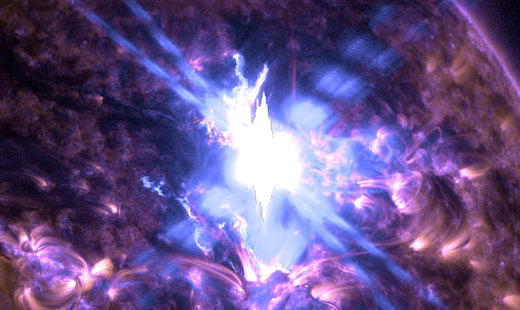
An extreme UV image of the Nov. 11, 2025, X5-class solar flare. Credit: NASA/SDO
A new paper published in the peer-reviewed journal Space Weather reveals a surprise. "The storm was even stronger than we thought," says co-author Clive Dyer of the University of Surrey.
Luckily, the Surrey team was in a meeting with the UK Met Office when the storm began. Within an hour, a weather balloon carrying a radiation detector lifted off from Lerwick in the Shetland Islands. More balloons followed from Cornwall and the Netherlands, and detectors rode aboard two transatlantic airliners.
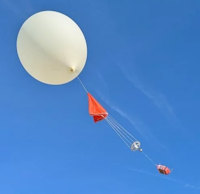 Over Shetland, the balloons measured startling dose rates where planes fly. At 48,000 ft (business jets), radiation doubled--enough to cross the International Civil Aviation Organization's "moderate" threshold. At 60,000 ft (supersonic jets), it was nearly 5 times normal and twice the "severe" threshold. Higher up, it kept climbing.
"[We measured] 300 µSv/hr--which may be the most intense natural atmospheric radiation field observed," the authors wrote. That's about 40 times the dose rate airline passengers normally receive.
Yet no aviation radiation warnings were issued. Forecasters rely on computer models, and the only model with published results said "moderate" levels were exceeded for no more than 10 minutes--a clear failure.
Colloquially, this has been called "the Veterans Day storm," but it has a technical name: GLE 77--the 77th ground level enhancement (GLE) since counting began in 1942. GLE 78 (whenever it happens) could be just as big. The authors call for a global network of rapid-response balloons to monitor future storms for air travelers.
You can read the original research here.


No comments:
Post a Comment