
F*CKING BAD
A POTENTIALLY DANGEROUS SUNSPOT: Big sunspot 4551 has a 'beta-gamma-delta' magnetic field that harbors energy for X-class solar flares. Any explosions today will be geoeffective because the sunspot is directly facing Earth. Solar flare alerts: SMS Text
SPACE MIRROR DRESS REHEARSAL: This week, the San Francisco Chronicle reported an unusual event in the Eastern Sierra foothills near Lone Pine, California. After sunset on Saturday, Oct. 10th, two incredibly bright beams of light lanced down from the mountains near Mt. Whitney, flooding the desert floor with light.
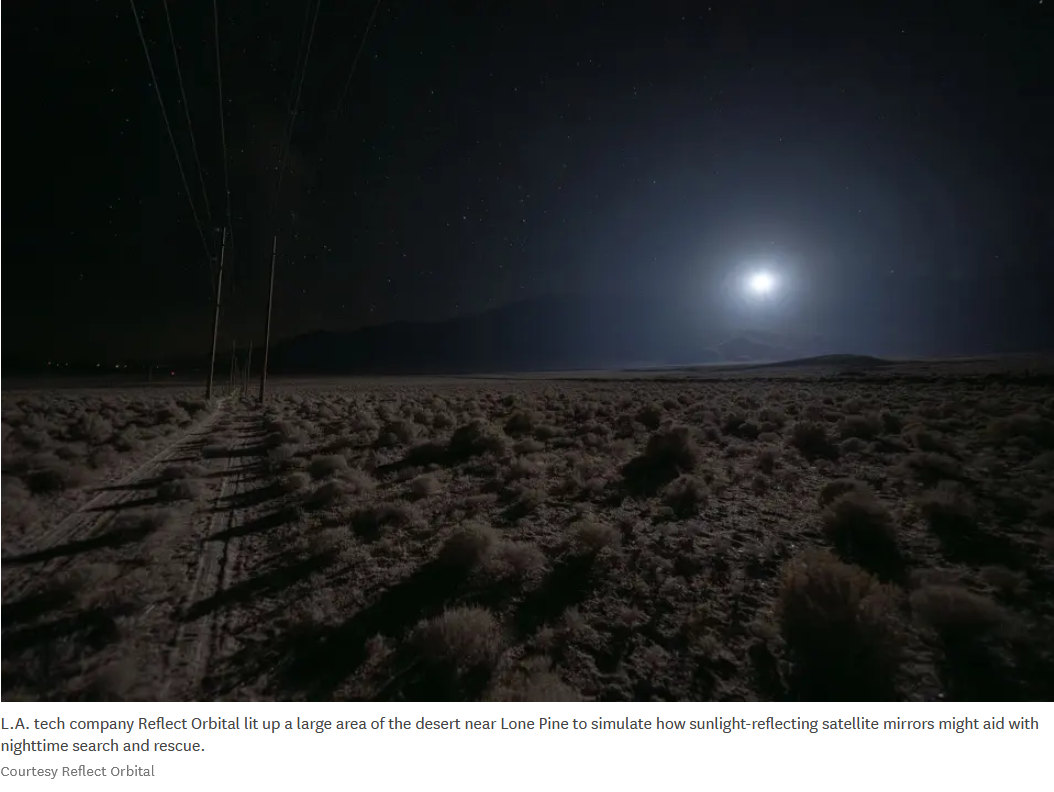
Above: Reflect Orbital lit up the desert to simulate how sunlight-reflecting satellite mirrors might aid with nighttime search and rescue.
"They were blinding," Lone Pine resident Cayden Thompson told the Chronicle. "It was pretty evident that this [was] not headlights or anything like that."
When Thompson and a friend drove up Horseshoe Meadows Road to investigate, they found a pair of spotlights parked in a dirt pullout. A technician warned them to keep back. The lamps were hot enough to burn.
It turns out, the blistering spotlights belonged to Reflect Orbital, an L.A.-based company that calls itself "the Sunlight Company." By launching huge mirrors to orbit, it plans to direct beams of sunlight onto the nightside of Earth.
An outlandishly bad idea, you say? The FCC approved their first satellite, Eärendil-1, in July, with launch tentatively scheduled for the second quarter of 2027.
 Oct. 10th was a test run, with lamps standing in for space mirrors. The company wanted to show how lights could help search and rescue (SAR) teams during nighttime emergencies. (Fun fact: Modern elastic-strap headlamps widely used by SAR were invented in 1973.)
Volunteers from the China Lake Mountain Rescue Group participated. "There was definitely an awe factor," group leader Phillip Cash told the Chronicle. "There’s no light and then suddenly you can see 3 miles around you in every direction."
According to Cash, the light was a little brighter than a full Moon. It helped, he said, but rescuers are “pretty good at working at night already.”
Eärendil-1 won’t work like a spotlight. From 625 km up, a single mirror can light a target for only about 5 minutes per pass. An all-night search would need a relay of satellites. This is one reason the company wants 50,000 of them by 2035.
Astronomers should finish their work before then.


No comments:
Post a Comment