


Sonic Booms Shook the U.S. For Over 300 Years
Here's what you'll learn when you read this story:
The "Seneca Guns" or "Seneca Drums" phenomenon of deep, echoing booms coming from New York's Seneca Lake went unsolved for centuries.
Local lore whispered of everything from ghosts to aliens, but scientists who were mapping the lakebed found something suspicious and decided to investigate.
As it turns out, the intense rumbling comes from enormous bubbles of methane that break through the bottom of the lake and explode once they reach the surface.
Seneca Lake appears tranquil, a summer escape in upstate New York where vacationers meander down the sand and sailboats bob lazily on rippling waves. Its shores are surrounded by wineries, resorts with postcard views, parks, farms, and stretches of verdant forest. Nearby villages are dotted with quaint cottages. Gazing across its deep blue expanse makes it almost impossible to think that something about this lake has caused nightmares.
But the deepest of the Finger Lakes hides secrets down below. Many have heard what can only be described as cannon shots coming out of nowhere. Known as "Seneca guns" or "Seneca drums," the phenomenon was thought by the local Seneca Tribe to be the bellowing shouts of Manitou, the Great Spirit, when he was angry. Later, European settlers thought they were hearing ghosts of Seneca warriors still fighting for their land as the ground turned red with blood. It also inspired James Fenimore Cooper to write his short story The Lake Gun, in which he observes:
"A sound resembling the explosion of a heavy piece of artillery, that can be accounted for by none of the known laws of nature. The report is deep, hollow, distant, and imposing. The lake seems to be speaking to the surrounding hills, which send back the echoes of its voice in accurate reply."
Modern legends that attempt to account for the phenomenon include alien spacecraft plunging into the lake or sonic booms from developing technology being beta-tested undercover by the government. Neither rumor can possibly be believed, since residents have been bombarded by the explosive sounds since at least the 1700s. They have been heard as far as New Jersey, Pennsylvania, North Carolina, and even Florida. Reports sometimes made the papers when the lake boomed every few years before going silent. The rise of social media had everyone who heard the booms logging onto their Facebook groups and typing "Did you hear it?" as fast as they could. Those who claimed to have heard the sound reported it occurring at the exact same moment.
Researcher Tim Morin, of SUNY ESF (Environmental Science and Forestry) in Syracuse, New York, had another idea: that there could be a physical explanation for it. As early as the 19th century, scientists were theorizing that the mysterious booms could be explosions of gas trapped in the lakebed. Geologist Herman Fairchild proposed the same thing in 1934 when he stated that "the explanation is bubbles of natural gas escaping from a layer of sandstone deep in the earth and coming up through the waters of the lake, where they burst with a booming sound." In 1971, geoscientist William F. Ahrnsbrak said it was "conceivable" that methane bubbles were bursting through the mud.
Morin and his research team from SUNY ESF and Cornell University had initially set out on another mission. While using sonar to survey the lake's fabled shipwrecks, they found the lakebed was pockmarked with 144 huge craters, each around 30 feet deep and 400 feet wide. They sampled lake water and material from deep pockets of sediment in the darkest reaches of the lake. These samples finally gave away Seneca Lake's secret. In the lab, Morin found traces of methane and other gases that occur beneath the lake, proving what Fairchild and Ahrnsbrak had predicted earlier without advanced enough equipment to investigate.
The booms were not aliens or cryptids or phantom battles, but monstrous bubbles of methane that would erupt from under the lakebed after years of pressure buildup, leaving craters behind. When a bubble reaches the surface, it ruptures with enough force to send a shockwave that sounds like cannon fire across the lake. That was the ghostly firing that had echoed through many restless nights. The lake's immense volume also has something to do with literally turning up the volume. Because it holds about 4.2 trillion gallons of water and is up to 618 feet deep in some places, with a lakebed that reaches 200 feet below sea level, it acts as an amplifier for the infamous booms.
Seneca Lake formed from an ancient glacier that melted after the last Ice Age. For scientists, it's an example that shows just how much gas might be lurking under similar lakes, and it can be usefully compared to other similar "lake gun" phenomena across the planet. Some even belch out amounts of methane that could be potentially lethal. But Seneca Lake's cannons aren't a deadly threat of that kind, and the recent slowdown in booms is a piece of welcome relief for light sleepers and the easily startled.


change the way we think about religion?

Societies grow and change all the time, but it can be tough to think about big-picture shifts when you’re living through the practical details of the day to day. Take the recent popularity of large language models (LLMs). In the short term, we face important sociological questions about how they fit into the norms of everyday life. Is it cheating to use an LLM to help you write, or to generate new ideas? How will new kinds of automation change work, or will they take jobs away?
These are important questions, but it is also useful to take a step back and think about what rapid developments in technology might do to our foundational social relationships and core beliefs. I was fascinated by a recent set of studies published in PNAS that suggest automated work and LLMs could even change the way we think about religion.
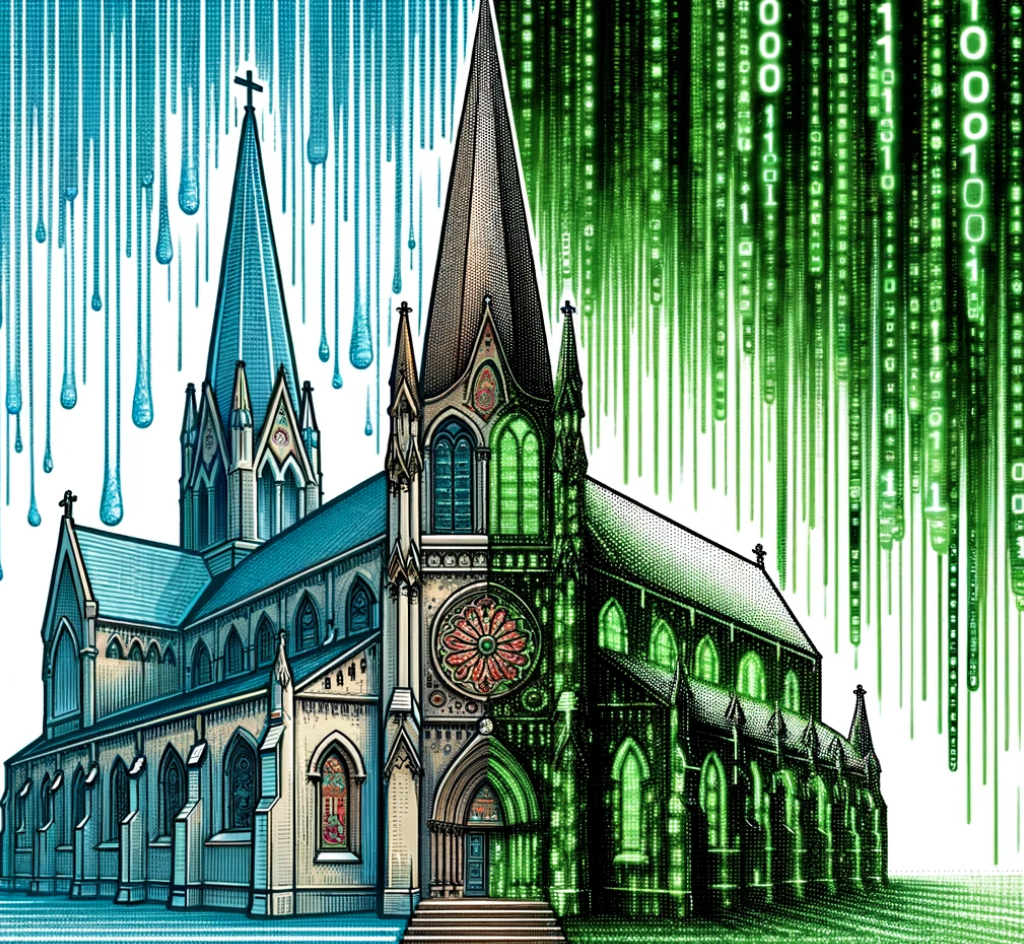
In the article “Exposure to Automation Explains Religious Declines,” authors Joshua Conrad Jackson, Kai Chi Yam, Pok Man Tang, Chris G. Sibley, and Adam Waytz review the findings from five studies. In one, their analysis of longitudinal data across 68 countries from 2006 to 2019 finds nations with higher stocks of industrial robots also tend to have lower proportions of people who say religion is an important part of their daily lives in surveys.

I was most surprised by the results of their fifth study—an experiment teaching people about recent advances in science and AI. Respondents who read about the capabilities of LLMs like ChatGPT showed “greater reductions in religious conviction than learning about scientific advances” (8).
The authors suggest one reason for this pattern is that “people may perceive AI as having capacities that they do not ascribe to traditional sciences and technologies and that are uniquely likely to displace the instrumental roles of religion” (2). This is important for us, whether or not you’re personally religious, because religion is a socially powerful force – people use shared beliefs to accomplish things in the world and solve problems, even to cope with hardships like losing a job.
But these results show that new changes in technology, like the advent of LLMs, might be expanding people’s imaginations about what we can do and achieve, possibly even changing the core beliefs that are central to their lives over the long term.
Evan Stewart is an assistant professor of sociology at University of Massachusetts Boston. You can follow his work at his website, or on BlueSky.
Subscribe to:
Posts (Atom)


oh yeah...


-
airlinepilotguy.com PIGS CAN FLY? From best friend to therapist: Research on emotional support animals It turns out pigs can fly. And turtle...
-
Burt Bacharach, Music artist Co-author (with lyricist Hal David) of an extensive string of hits in the '60s, Burt Bacharach is one of...


