This is an AI Free Zone: AI is everywhere -- except here.
Spaceweather.com is written by Dr. Tony Phillips, a carbon-based
lifeform with 30 yrs of forecasting experience. If you find a mistake,
rest assured it was made by a real human being.
ANTARCTIC TONGUES OF IONIZATION: "Tongues
of ionization" sound like alien anatomy, but they come from Earth.
They're plasma rivers in our planet's ionosphere. During the great
geomagnetic storm of May 2024, a dense tongue swept over Antarctica,
scrambling GPS with position errors as large as 28 meters. The
remarkable event is described in a new paper just published in the research journal Space Weather. Free:Space Weather Newsletter
A GIANT ATMOSPHERIC CHEMISTRY EXPERIMENT: Every
16 hours, a Starlink satellite falls out of the sky. It's part of the
SpaceX business model: Old obsolete satellites re-enter to make way for
newer models. This may sound like a good way to keep Earth orbit from
becoming too cluttered, but it comes with a cost. Every Starlink that
burns up dumps about 30 kg of aluminum oxide into the upper atmosphere.
That aluminum is not supposed to be there.
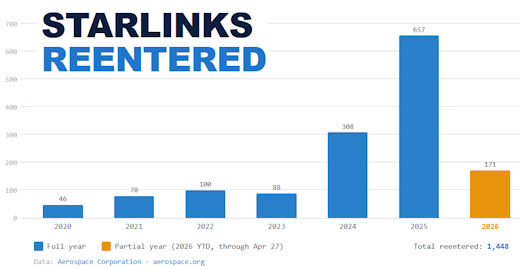
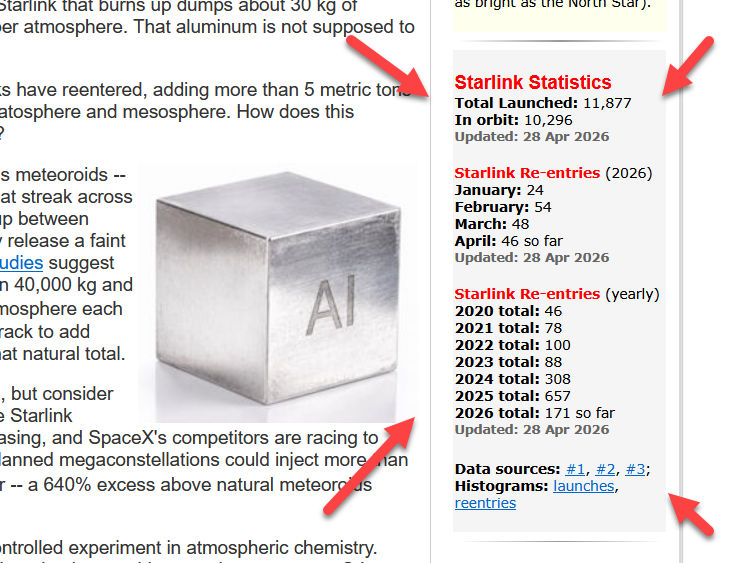
This histogram of Starlink re-entries is updated daily on Spaceweather.com
So far this year (April 28, 2026), 171
Starlinks have reentered, adding more than 5 metric tons (5,000 kg) of
aluminum oxide to the stratosphere and mesosphere. How does this compare
to natural sources?
The
primary natural source is meteoroids -- the same "shooting stars" that
streak across the night sky. As they burn up between roughly 75 and 110
km, they release a faint dusting of metals. Recentstudies
suggest that meteoroids disperse between 40,000 kg and 58,000 kg of
Al₂O₃ into the atmosphere each year. Starlink in 2026 is on track to add
between 26% and 39% of that natural total.
39% may not sound too bad, but consider the following: The size of the Starlink constellation
is rapidly increasing, and SpaceX's competitors are racing to catch up.
A full buildout of planned megaconstellations with corresponding
re-entries could inject more than 360,000 kg of Al₂O₃ per year -- a 640%
excess above natural meteoroids (Ferreira et al. 2024).
It all adds up to a giant uncontrolled
experiment in atmospheric chemistry. Researchers already know that
aluminum oxides can destroy ozone in a complex series of steps involving
Al₂O₃, HCl, AlCl₃, sunlight, Cl, and O₃. Other side-effects may reveal
themselves in time.
Stay informed: Daily updated totals of Starlink launches and reentries are posted here on Spaceweather.com.
Everything You Need to Know About This Surveillance Tech
Flock Safety is setting up cameras and drones across the country. I
spoke to cities and privacy advocates fighting back against the AI
surveillance, including Flock and others like it.
Tyler Lacoma
Flock surveillance cameras and drones are now common: Here's what they can do.
CNET Art
I have up-close experience with Flock, as my current city, Bend, Oregon, ended its contract with surveillance company Flock Safety earlier
this year, after a public campaign protesting the cams -- and some very
active city council meetings. Flock's controversial AI-powered license plate cameras were shut down, and its partnership with local law enforcement ended over privacy concerns.
We weren't the only city to reject Flock cameras: In the past two years, dozens of towns have
suspended or deactivated contracts with Flock over concerns about how
the cameras could be used, as well as weak contract language. But you
might not even know if Flock has come to your town: Sometimes these
automated license plate readers, or ALPRs, appear in neighborhoods
without warning.
Flock gripped news headlines late last year when it was under the microscope during widespread crackdowns by Immigration and Customs Enforcement.
Though Flock doesn't have a direct partnership with federal agencies (a
blurry line I'll discuss more), law enforcement agencies are free to
share data with departments like ICE, and they frequently do.
One study from
the Center for Human Rights at the University of Washington found that
at least eight Washington law enforcement agencies shared their Flock
data networks directly with ICE in 2025, and 10 more departments allowed
ICE backdoor access without explicitly granting the agency permission.
Many other reports outline similar activity.
Following Super Bowl ads about finding lost dogs, Flock was under scrutiny about its planned partnership with Ring,
Amazon's security brand. The integration would have allowed police to
request the use of Ring-brand home security cameras for investigations.
Following intense public backlash, Ring cut ties with Flock just like my city did.
To
learn more, I spoke to Flock about how the company's surveillance
technology is used (and misused). I also spoke with privacy advocates
from the American Civil Liberties Union to discuss surveillance concerns
and what communities are doing about it.
What it means when Flock Safety sets up
Flock's presence means license plate cameras -- and these days, much more.
Bloomberg/Contributor/Getty Images
If
you hear that Flock is setting up near you, it usually means the
installation of ALPR cameras to capture license plate photos and monitor
cars on the street.
Flock signs contracts with a wide range of
entities, including city governments and law enforcement departments. A
neighborhood can also partner with Flock -- for example, if an HOA
decides it wants extra eyes on the road, it may choose to use Flock's
systems.
When Flock secures a contract, the company installs cameras at strategic locations. Though these cameras are primarily marketed for license plate recognition, Flock reports
on its site that its surveillance system is intended to reduce crime,
including property crimes such as "mail and package theft, home
invasions, vandalism, trespassing, and burglary." The company also says
it frequently solves violent crimes like "assault, kidnappings,
shootings and homicides."
Flock
has recently expanded into other technologies, including advanced
cameras that monitor more than just vehicles. Most concerning are the latest Flock drones equipped with high-powered cameras. Flock's "Drone as First Responder"
platform automates drone operations, including launching them in
response to 911 calls or gunfire. Flock's drones, which reach speeds up
to 60 mph, can follow vehicles or people and provide information to law
enforcement.
Drones like these can be used to track fleeing suspects.
In practice, the key is how law enforcement chooses to use them, and
whether states pass laws allowing police to use drones without a warrant
-- I'll cover state laws more below, because that's a big part of
today's surveillance.
It's important to note that not all cities
or neighborhoods refer to Flock Safety by name, even when using its
technology. They might mention the Drone as First Responder program, or
ALPR cameras, without further details. For example, a March announcement about police drones from the city of Lancaster, California, doesn't mention Flock at all, even though it was the company behind the drone program.
Current Time 0:16
Duration 5:07
How Flock uses tech to ID cars -- and people
Flock has expanded from cameras to drones, and with that comes greater ability to track people as well as cars.
Connecticut Post/Hearst Newspapers/Getty Images
Flock states on its website that its standard license-plate cameras cannot technically track vehicles, but only take a "point-in-time" image of a car to nab the license plate.
However,
due to AI video and image search, contracted parties like local law
enforcement can use these tools to piece together license information
and form their own timeline of where and when a vehicle went. Adding to
those capabilities, Flock also told Forbes that it's making efforts to expand access to include video clips and live feeds.
Flock's machine learning can
also note details like a vehicle's body type, color, the condition of
the license plate and a wide variety of identifiers, like roof racks,
paint colors and what you have stored in the back. Flock rarely calls
this AI, but it's similar to AI-recognition features you can find in the latest home security cameras
A
Flock spokesperson told me the company has boundaries and does not use
facial recognition. "We have more traditional video cameras that can
send an alert when one sees if a person is in the frame, for instance,
in a business park at 2 a.m. or in the public parks after dark."
By
"traditional" cameras, Flock refers to those that capture a wider field
of view -- more than just cars and license plates -- and can record
video rather than just snapshot images.
The
information Flock can access provides a comprehensive picture that
police can use to track cars by running searches on their software. Just
like you might Google a local restaurant, police can search for a basic
vehicle description and retrieve recent matches that the surveillance
equipment may have found. Those searches can sometimes extend to people,
too.
"We have an investigative tool called Freeform that lets you
use natural language prompts to find the investigative lead you're
looking for, including the description of what a person's clothes may
be," the Flock spokesperson told me.
Unlike red-light cameras,
Flock's cameras can be installed nearly anywhere and snap vehicle ID
images for all cars. There are Safe Lists that people can use to help
Flock cameras filter out vehicles by filling out a form with their
address and license plate to mark their vehicle as a "resident."
The
opposite is also true: Flock cameras can use a hot list of known,
wanted vehicles and send automatic alerts to police if one is found.
With
Flock drones, these intelligent searches become even more complete,
allowing cameras to track where cars are going and identify people. That
raises additional privacy concerns about having eyes in the sky over
your backyard.
"While
flying, the drone faces forward, looking at the horizon, until it gets
to the call for service, at which point the camera looks down," the
Flock spokesperson said. "Every flight path is logged in a publicly
available flight dashboard for appropriate oversight."
Yet unlike
personal security options, there's no easy way to opt out of this kind
of surveillance. You can't turn off a feature, cancel a subscription or
throw away a device to avoid it.
And even though more than 45
cities have canceled Flock contracts amid public outcry, that doesn't
guarantee that all surveillance cameras will be removed from the
designated area.
When I reached out to the police department in
Eugene, another city in Oregon that ended its Flock contract, the PD
director of public information told me that, while there were concerns
about certain vulnerabilities and data security requirements with the
particular vendor, the technology itself is not the problem. "Eugene
Police's ALPR system experience has demonstrated the value of leveraging
ALPR technology to aid investigations … the department must ensure that
any vendors meet the highest standards."
Does Flock track personal information? The devil is in the details
License plates can be closely connected to your personal information.
Joa_Souza/Getty Images
Flock's stance, as outlined in its privacy and ethics guide,
is that license plate numbers and vehicle descriptions aren't personal
information. The company says it doesn't surveil "private data" -- only
cars and general descriptive markers.
But vehicle information can be considered personal because it's legally tied to the vehicle's owner. Privacy laws, including proposed federal legislation from 2026, prohibit the release of personal information from state motor vehicle records in order to protect citizens.
AI detection also plays a role. When someone can identify a vehicle through searches like "red pickup truck with a dog in the bed,"
that tracking goes beyond basic license plates to much more personal
information about the driver and their life. It may include the bumper
stickers, what can be seen in the backseat and whether a vehicle has a
visible gun rack.
Flock's practices -- like its recent push toward
live video feeds and drones to track suspects -- move out of the gray
area, and that's where privacy advocates are rightly concerned. Despite
its policy, it appears you can track specific people using
Flock tech. You'll just need to pay more to do so, such as upgrading
from ALPRs to Flock's suspect-following drone program, or using its
Freeform tool to track someone by the clothes they're wearing.
How does Flock Safety handle the data it collects?
Flock's security practices are solid, but it's the company's users I'm worried about.
Anadolu/Contributor/Getty Images
Flock states on its website that it stores data
for 30 days on Amazon Web Services cloud storage and then deletes it.
It uses KMS-based encryption (a managed encryption key system common in
AWS) and reports that all images and related data are encrypted from
on-device storage to cloud storage.
When Flock collects criminal
justice information, or sensitive data managed by law enforcement, it's
only available to official government agencies, not an entity like your
local HOA. Because video data is encrypted throughout its transfer to
the end user, employees at Flock cannot access it. These are the same
kind of security practices I look for when reviewing home security cameras, but there are more complications here.
However,
Flock also makes it clear that its customers -- whether that's a local
police department, private business or another institution -- own their
data and control access to it. Once end users access that data, Flock's
own privacy measures don't do much to help. That raises concerns about
the security of local law enforcement systems, each of which has its own
data regulations and accountability practices.
Abuse of Flock data
Flock can audit camera access, but that hasn't prevented bad behaviors so far.
Matthew Jonas/Boulder Daily Camera/Getty Images
You
may have noticed a theme: Flock provides powerful surveillance
technology, and the final results are deeply influenced by how customers
use it. That can be creepy at best, and an illegal abuse of power at
worst.
Since
Flock Safety began partnering with law enforcement, a growing number of
officers have been found abusing the surveillance system. In one
instance, a Kansas police chief used Flock cameras 164 times while tracking an ex. In another case, a sheriff in Texas lied about using Flock to "track a missing person," but was later found to be investigating a possible abortion. In Georgia, a police chief was arrested
for using Flock to stalk and harass citizens. In Virginia, a man sued
the city of Norfolk over purported privacy violations and discovered
that Flock cameras had been used to track him 526 times, around four times per day.
Those
are just a few examples from a long list, giving real substance to
worries about a surveillance state and a lack of checks and balances.
When I asked Flock how its systems protect against abuse and overreach, a
spokesperson referred to its accountability feature, an auditing tool
that "records every search that a user of Flock conducts in the system."
Flock used this tool during the Georgia case above, which ultimately
led to the arrest of the police chief.
While police search logs are often tracked like this, reports indicate
that many authorities start searches with vague terms and cast a wide
net using terms like "investigation," "crime" or a broad immigration
term like "deportee" to gain access to as much data as possible. While
police can't avoid Flock's audit logs, they can use general or
discriminatory terms -- or skip filling out fields entirely -- to evade
investigations and hide intent.
Regardless
of the auditing tools, the onus is on local organizations to manage
investigations, accountability and transparency. That brings me to a
particularly impactful current event.
Flock, ICE and the federal government: Data sharing complications
While ICE can't directly access Flock's system, they tend to get a lot of help from local law enforcement.
Douglas Rissing/Getty Images
ICE
is the elephant in the room in my Flock guide. Does Flock share its
surveillance data with federal agencies such as ICE? Yes, the federal
government frequently has access to that data, but how it gets access is important.
Flock states
on its website that it has not shared data or partnered with ICE or any
other Department of Homeland Security officials since terminating its pilot programs
in August 2025. Flock says its focus is now on local law enforcement,
but that comes with a hands-off approach that doesn't control what
happens to information downstream.
"Flock has no authority to
share data on our customers' behalf, nor the authority to disrupt their
law enforcement operations," the Flock spokesperson told me. "Local
police all over the country collaborate with federal agencies for
various reasons, with or without Flock technology. "
That collaboration has grown more complex. As Democratic Senator Ron Wyden from Oregon stated in an open letter to Flock Safety,
"local" law enforcement isn't that local anymore, especially when 75%
of Flock's law enforcement customers have enrolled in the National Lookup Tool, which allows information sharing across the country between all participants.
"Flock
has built a dangerous platform in which abuse of surveillance data is
almost certain," Wyden wrote. "The company has adopted a see-no-evil
approach of not proactively auditing the searches done by its law
enforcement customers because, as the company's Chief Communications
Officer told the press, 'It is not Flock's job to police the police.'"
Police department sharing isn't always easy to track, but reporting from 404 Media
found that police departments across the country have been creating
Flock searches with reasons listed as "immigration," "ICE," or "ICE
warrant," among others. Again, since police can put whatever terms they
want in these fields -- depending on local policies -- we don't know for
sure how common it is to look up info for ICE.
Additionally, there's not always an official process or chain of accountability for sharing this data. In Oregon, reports found that a police department was conducting Flock searches on behalf of ICE and the FBI via a simple email thread.
"When
this kind of surveillance power is in malevolent hands -- and in the
case of ICE, I feel comfortable saying a growing number of Americans
view it as a bad actor -- these companies are empowering actions the
public increasingly finds objectionable," a lawyer with the ACLU told a Salt Lake City news outlet earlier this year.
With
the myriad ways law enforcement shares Flock data with the federal
government, it may seem like there's not much you can do. But one
powerful tool is advocating for new laws.
The rise of laws limiting what Flock Safety and police can do
State laws differ drastically when it comes to Flock surveillance, but legislation is on the rise.
Klaus Vedfelt/Getty Images
In
the past two years, a growing number of state laws have been passed or
proposed to address Flock Safety, license plate readers and
surveillance. Much of this legislation is bipartisan, or has been passed
by both traditionally right- and left-leaning states, although some go
further than others.
When I contacted the ACLU to learn what
legislation is most effective in situations like this, Chad Marlow,
senior policy counsel and lead on the ACLU's advocacy work for Flock and
related surveillance, gave several examples.
"I would limit the
allowed uses for ALPR," Marlow told me. "While some uses, like for toll
collection and Amber Alerts, with the right guardrails in place, are not
particularly problematic, some ALPRs are used to target communities of
color and low-income communities for fine/fee enforcement and for minor
crime enforcement, which can exacerbate existing policing inequities."
This
type of harmful ALPR targeting is typically used to both oppress
minorities and bring in a greater number of fees for local law
organizations -- problems that existed long before AI recognition
camera, but have been exacerbated by the technology.
New
legislation can help, but it needs to be carefully crafted. The most
effective laws fall into two categories. The first is requiring any
collected ALPR or related data to be deleted within a certain time frame
-- the shorter, the better. New Hampshire wins here with a 3-minute
rule.
"For states that want a little more time to see if captured
ALPR data is relevant to an ongoing investigation, keeping the data for a
few days is sufficient," Marlow said. "Some states, like Washington and
Virginia, recently adopted 21-day limits, which is the very outermost
acceptable limit."
The second type of promising law makes it
illegal to share ALPR and similar data outside the state (such as with
ICE) and has been passed by states like Virginia, Illinois and
California.
"Ideally,
no data should be shared outside the collecting agency without a
warrant," Marlow said. "But some states have chosen to prohibit data
sharing outside of the state, which is better than nothing, and does
limit some risks."
But
what happens if police choose to ignore laws and continue using Flock
as they see fit? That's already happened. In California, for example,
police in Los Angeles and San Diego were found sharing information with Homeland Security in 2025, in violation of a state law that bans organizations from sharing license plate data out of state.
When this happens, the recourse is typically a lawsuit, either from the state attorney general or a class action by the community, both of which are ongoing in California in 2026. But what should people do while legislation and lawsuits proceed?
Living with Flock Safety and its growing competitors
Many other AI surveillance tools are appearing, including some aimed at law enforcement and businesses.
NurPhoto/Contributor/Getty Images
Marlow acknowledged that individuals can't do much about Flock surveillance without bans or legislation.
"Flock
identifies and tracks your vehicle by scanning its license plate, and
covering your license plate is illegal, so that is not an option," he
told me.
However, Marlow suggested minor changes that could make a
difference for those who are seriously worried. "When people are
traveling to sensitive locations, they could take public transportation
and pay with cash (credit cards can be tracked, as can share-a-rides) or
get a lift from a friend, but those aren't really practical on an
everyday basis."
Ditching
or restricting Flock Safety is one way communities are fighting back
against what they consider to be unnecessary surveillance with the
potential for abuse. But AI surveillance doesn't begin or end with one
company.
When multiple companies, including Motorola, are offering similar tools, the problem becomes much larger than Flock Safety tech.
Motorola Solutions
Flock
Safety is an intermediary that provides technology in demand by
powerful organizations. It's hardly the only one with these kinds of
high-tech eyes -- it's just one of the first to enter the market at a
national level. If Flock were gone, another company would likely step in
to fill the gap, unless restricted by law.
As Flock's
integration with other apps and cameras becomes more complex, it's going
to be harder to tell where Flock ends and another solution begins, even
without rival companies showing up with the latest AI tracking.
If you want to take an extra step, you can volunteer, donate and participate in a variety of anti-surveillance activities.
Institute for Justice
The
first step is being aware, including knowing which new cameras your
city is installing and which software partnerships your local law
enforcement has. If you don't like what you discover, find ways to
participate in the decision-making process, like attending open city council meetings on Flock, as in Bend.
On
a broader level, keep track of the legislation your state is
considering regarding Flock and similar surveillance contracts and
operations, as these will have the greatest long-term impact. Blocking
data from being shared out of state and requiring police to delete
surveillance ASAP are particularly important steps. You can contact your
state senators and representatives to encourage legislation like this.
When
you're wondering what to share with politicians, I recommend something
like what Marlow told me: "The idea of keeping a location dossier on
every single person just in case one of us turns out to be a criminal is
just about the most un-American approach to privacy I can imagine."
You can also sign up for and donate to projects that are addressing Flock concerns, such as The Plate Privacy Project from The Institute for Justice. I'm currently talking to them about the latest events, and I'll update if they have any additional tips for us.
Tyler
has worked on, lived with and tested all types of smart home and
security technology for over a dozen years, explaining the latest
features, privacy tricks, and top recommendations.
With degrees in Business Management, Literature and Technical Writing,
Tyler takes every opportunity to play with the latest AI technology,
push smart devices to their limits and occasionally throw cameras off
his roof, all to find the best devices to trust in your life. He always
checks with the renters (and pets) in his life to see what smart
products can work for everyone, in every living situation.
Living in beautiful Bend, Oregon gives Tyler plenty of opportunities to
test the latest tech in every kind of weather and temperature. But when
not at work, he can be found hiking the trails, trying out a new food
recipe for his loved ones, keeping up on his favorite reading, or gaming
with good friends.See full bio
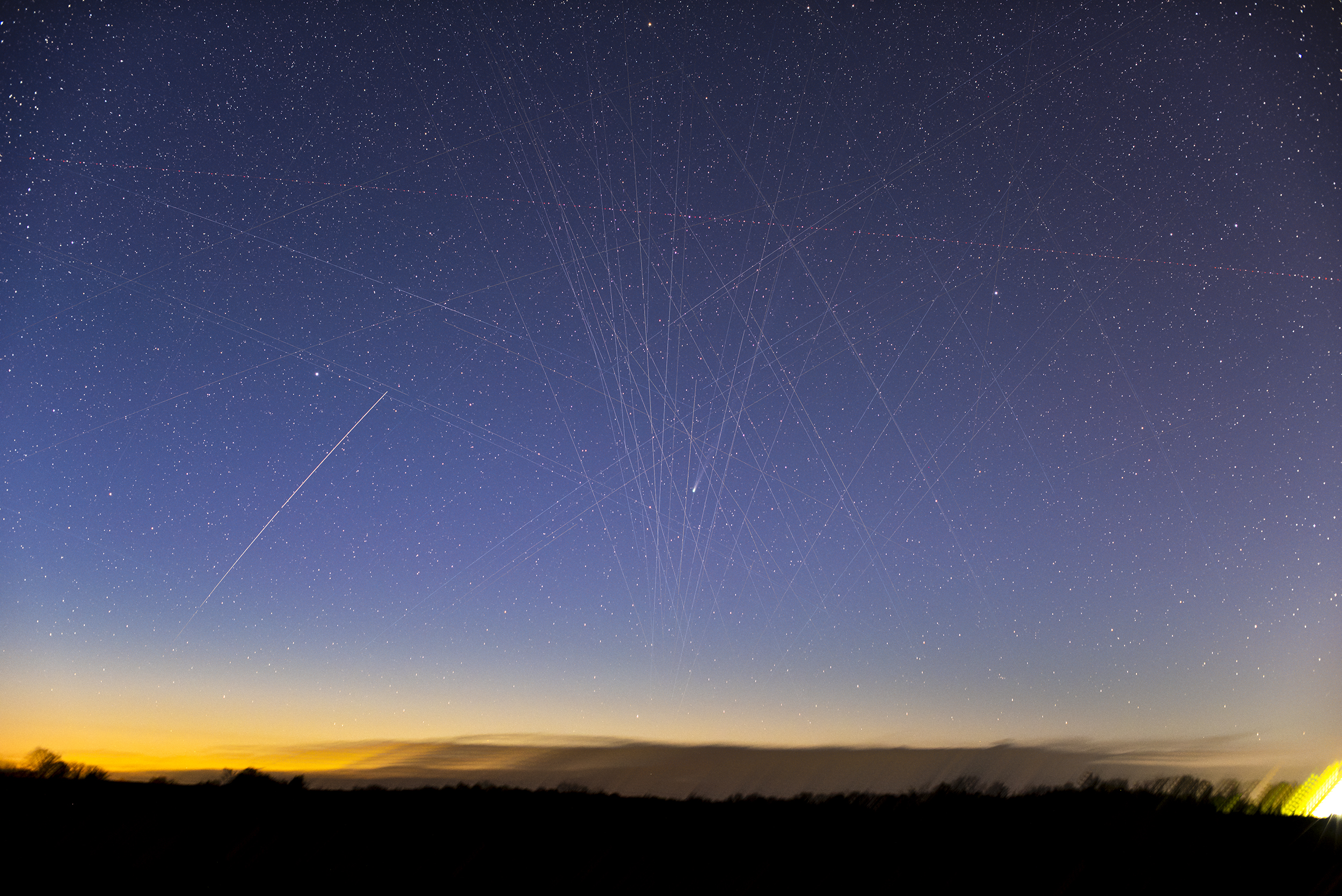
Earlier this year, the number of Starlink satellites in Earth orbit surpassed 10,000. You can see the evidence in the sky:
Dan
Bush took this picture before sunrise on April 16th from Albany,
Missouri. It's supposed to be a picture of Comet PanSTARRS (C/2025 R3),
but it contains far more satellites than comets--more than 35 Starlinks
in the full-frame photo.
"The
'Starlink Zone of Maximum Reflection' appeared right in front of the
comet," says Bush. "Stacking 30-second exposures helped alleviate the
satellites, but they're still there."
Bush's photo is no fluke. In the past year, the number of comet photos criss-crossed by satellites submitted to our gallery
has jumped more than 10-fold. The actual counts are certainly greater.
Many astrophotographers use software to remove the streaks (e.g.,
StarXTerminator and Cosmic Clarity), then submit the scrubbed photos
without mentioning that they were photobombed.
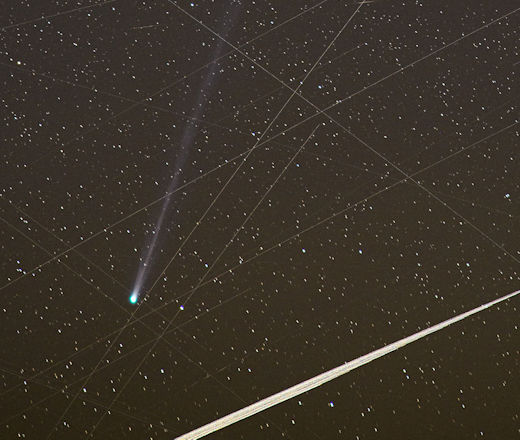
Sometimes,
Starlink is the point: "Like any good astrophotographer, I was out in
the pre-twilight hours of April 15th photographing Comet PanSTARRS,"
says David Blanchard of Mormon Lake, Arizona. This is what he saw:
"Having
Starlink satellites move across the image is expected these days -- but
I was not expecting this!" he says. "Some of the Starlinks were as
bright as Venus." (They had launched only 6 1/2 hours earlier and were
still in extra-bright low orbits.)
Comet
PanSTARRS is especially vulnerable to photobombing. It hugs the morning
horizon in a patch of twilight sky where Starlinks are outside of
Earth's shadow. There, the satellites do a great job reflecting
high-altitude sunlight into telescopes.
The Space Weather Photo Gallery
is 10+ years older than the Starlink program, and it contains phenomena
of all types--from Auroras to Zodiacal Lights. We find that comet
photos are disproportionately susceptible to interference. Comets tend
to be close to the sun, where Starlinks are brightest, and the field of
view + exposure time of a typical comet photo is perfect for catching
satellites.
Ultimately, SpaceX plans for 42,000 satellites. Note to the Editor: Next year, re-title this piece "The Good Old Days."
President Trump has given Iran until Tuesday at 8 p.m. ET (today) [now extended]
to reopen the Strait of Hormuz or face the destruction of every power
plant and bridge in the country. At a White House press conference, he
said:
“Every bridge in Iran will be decimated by 12 o’clock tomorrow night,
where every power plant in Iran will be out of business, burning,
exploding and never to be used again.”
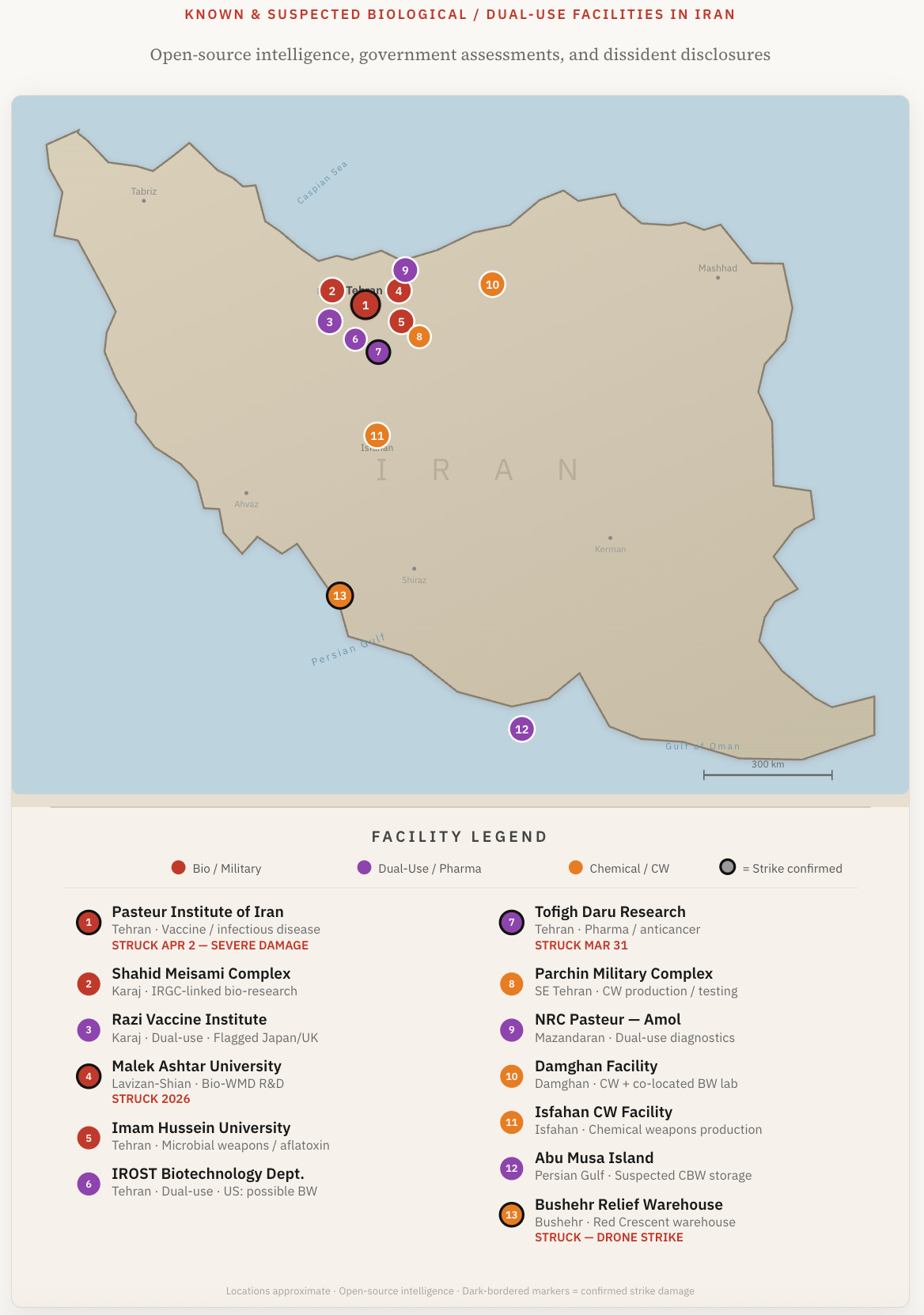
Iran’s known and suspected biological weapons facilities depend on
the same power grids and transport links that the White House has
promised to destroy. If “Power Plant Day” happens, the consequence
nobody is discussing is this: multiple dual-use biological facilities in Iran face simultaneous containment failure.
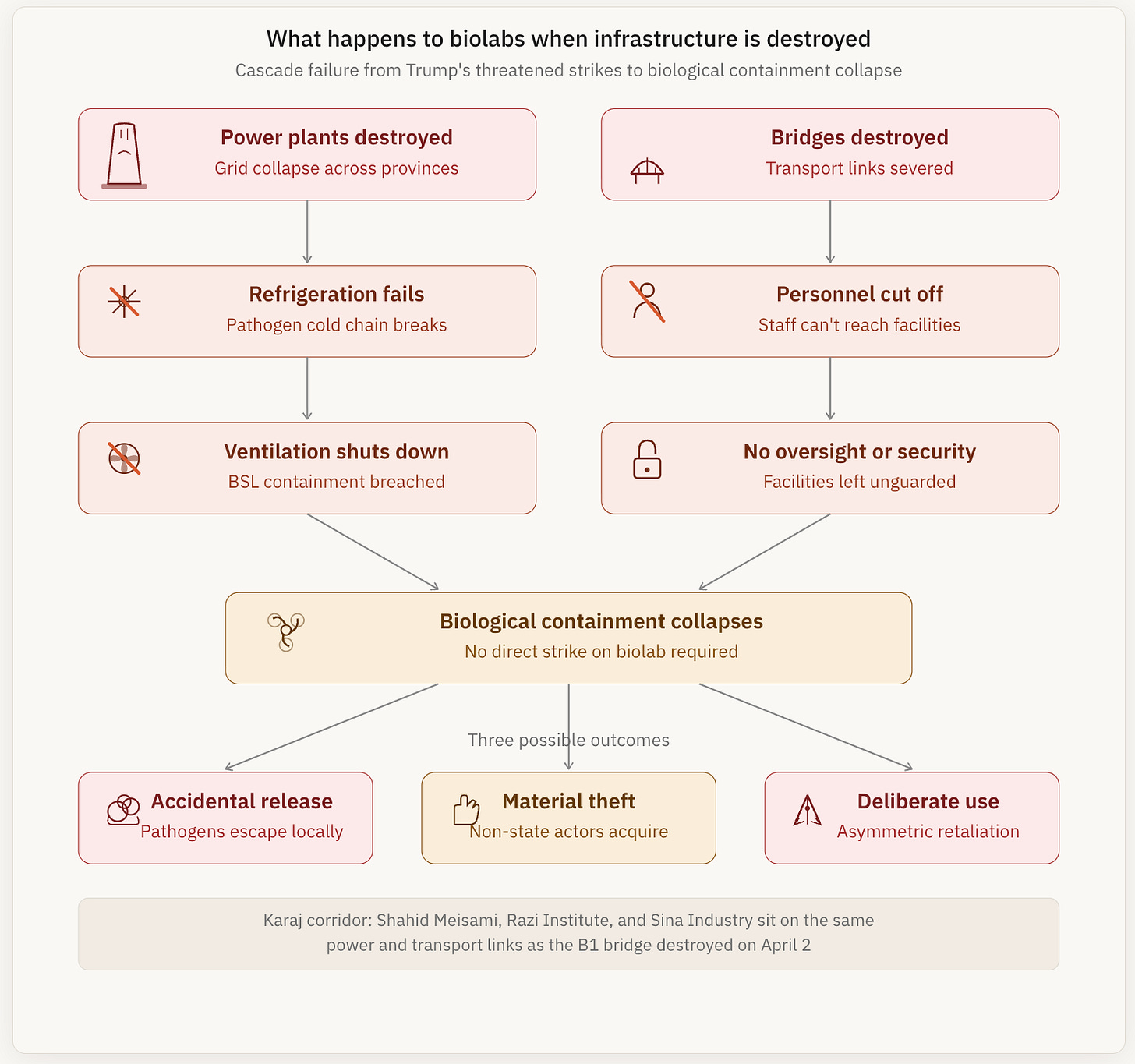
How Infrastructure Strikes Trigger Biolab Failure
Biological agents stored in research facilities require constant
refrigeration, negative-pressure ventilation, and trained personnel
oversight. These are not optional — they are the systems that prevent
pathogens from escaping into the environment. Destroy the power grid and
you destroy the cold chain. Destroy the bridges and you cut off the
personnel who maintain containment. The biolab doesn’t need to be struck
directly. The containment fails on its own.
Although these facilities typically have on-site emergency diesel
generators and battery backup systems, these redundancies are designed
only for short-term outages. Generator fuel supplies usually last
between 24 and 72 hours at most. When power plants across the country
are destroyed and key bridges are severed, diesel resupply becomes
impossible, maintenance crews cannot reach the sites, and personnel may
be unable or unwilling to remain on duty amid the chaos. Once the backup
systems fail, negative pressure ventilation collapses, refrigeration
units warm up, and biological containment is lost — even without any
direct strike on the laboratories themselves.
If containment fails, materials that could be released include
anthrax, plague bacteria (Yersinia pestis), botulinum toxin, and
aflatoxin — agents repeatedly linked by U.S. intelligence and NCRI
reports to Iran’s dual-use programs. Some facilities are also suspected
of bioregulator research for incapacitating or lethal effects. While
many cited agents have limited person-to-person spread, pneumonic plague
is highly contagious and has caused past pandemics; it could trigger
rapid regional or global outbreaks. Due to dual-use cover and limited
transparency, secret or genetically modified pathogens with enhanced
transmissibility or virulence cannot be ruled out.
The Bulletin of the Atomic Scientists confirmed
that the Shahid Meisami Research Complex, Imam Hussein University, and
Malek Ashtar University have all sustained strike damage across the 2025
and 2026 campaigns. The Pasteur Institute — Iran’s century-old vaccine and infectious disease center, but also flagged by Japan and Britain as a biological weapons proliferation concern — was severely damaged on April 2.
.
Biological containment depends on electricity, refrigeration,
ventilation, and personnel access — all of which collapse when you
destroy a country’s power grid and bridges. If “Power Plant Day” happens
tonight, multiple dual-use biological facilities in Iran could face
simultaneous containment failure.