Good Information here on How can we cure and prevent Cancer -
Cures has been known since the 1930’s.
Also see my podcast from years ago in Ecuador (2012). https://carlitashaw.substack.com/p/episode-48-the-cure-for-cancer-38c
Oldest Firearm in the US, A 500-Year-Old Cannon Unearthed in Arizona, Reveals Native Victory Over Conquistadores
5/2/2025
In
the southern Arizona desert, a fragment of forgotten history has
emerged from the dust: a bronze cannon, silent for nearly 500 years.
This relic is officially the oldest firearm ever found in the
continental United States. It was unearthed at the site of San Geronimo
III, a doomed settlement established during the Spanish conquest in
1541.
This
cannon tells a story of conquest, resistance, and one of the earliest
Native American victories against European colonizers.
The Town That Vanished
In
1540, Francisco Vázquez de Coronado led 400 soldiers, their families,
and about 1,500 Indigenous allies northward from Mexico. They sought the
fabled “Seven Cities of Gold.” It was a grueling journey. They drove
herds of livestock across mountains and deserts, relying on sparse water
sources and limited supplies. By 1541, they had reached southern
Arizona, where they established a settlement they called San Geronimo
III, or Suya.
San
Geronimo was the first European town in the American Southwest.
Coronado left behind 200 to 400 people — soldiers, servants, and
settlers — to build a permanent presence for the Spanish crown. So, they
constructed adobe and rock
buildings, tended to the sick, and defended the settlement’s perimeter
with walls and firearms like the bronze cannon. But what they envisioned
as a foothold for Spain was, in truth, a powder keg.
The
Sobaipuri O’odham, who farmed the rivers of southeastern Arizona, were
no strangers to outsiders. But the arrival of the Spanish brought abuses
that ignited tensions. The conquistadors seized food, enslaved women,
and punished dissent with mutilation. Noses, tongues, and hands were cut
off for minor offenses. These transgressions did not go unanswered.
In
the predawn hours of one fateful morning in 1541, the native Sobaipuri
launched a surprise attack on the town. Accounts differ on the details,
but the result was catastrophic for the Spanish. Many settlers were
killed in their beds, and the survivors fled in disarray. One story
tells of a priest wielding a broadsword in a desperate defense, who
managed to save six Spaniards. Still, the cannon — meant to intimidate
and protect — was never even loaded.
The Oldest Gun in the USA
Archaeologist Deni Seymour holding the cannon she discovered in southern Arizona. Credit: Deni Symour.
The
bronze hackbut lay hidden for nearly five centuries, buried under the
ruins of a collapsed building at the center of the battlefield.
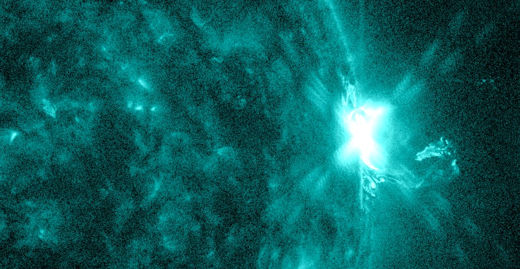
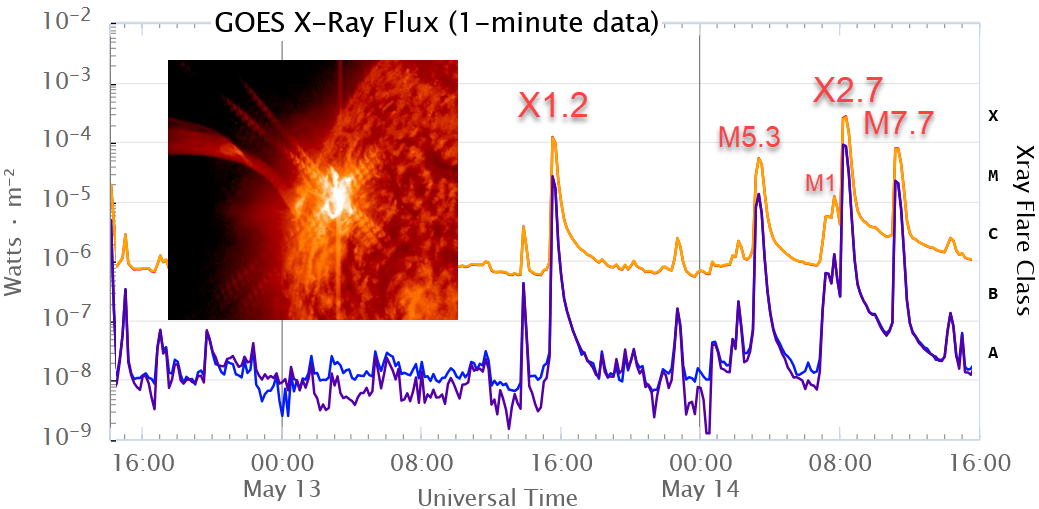
SO FAR THE CMEs ARE MISSING EARTH: A
fusillade of strong explosions from sunspot 4087 hurled multiple CMEs
into space today. So far none of the CMEs appears to be heading for
Earth. We are just outside the sunspot's strike zone. This could change
in the days ahead as the active region turns to face our planet.
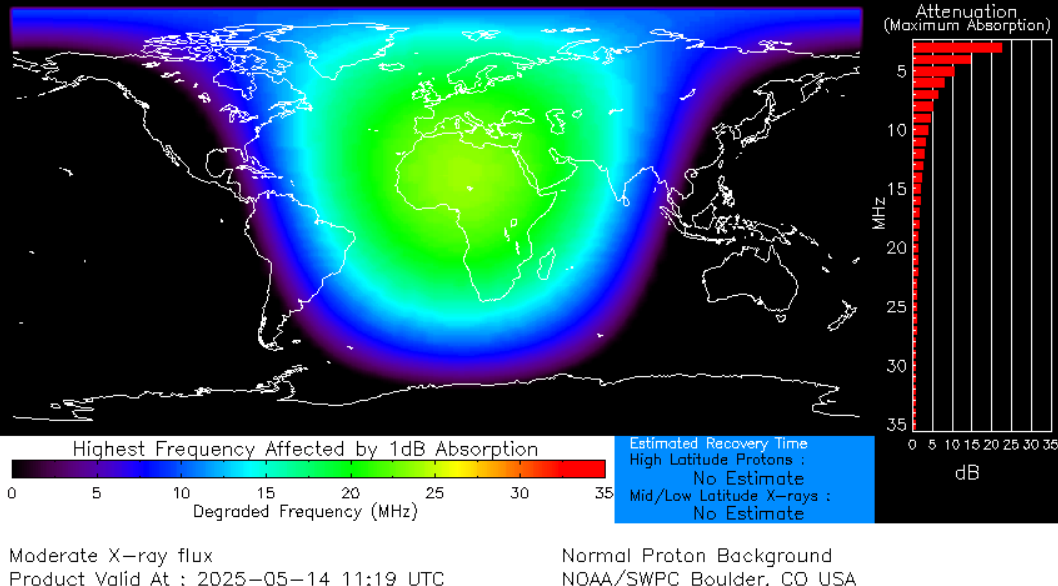
STRONG SOLAR ACTIVITY: After weeks of calm, solar activity is suddenly high again. The action started late yesterday with a surprising X1.2-class solar flare from the sun's western limb, followed today by an evenstrongerX2.7-flare from new sunspot 4087. Earth-orbiting satellites have detected four significant explosions so far:
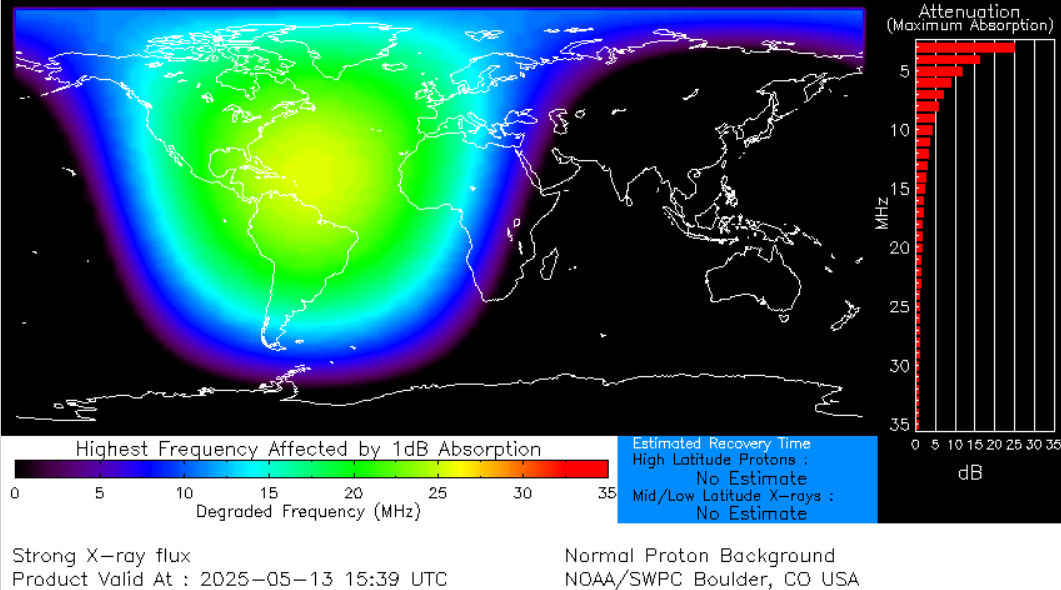
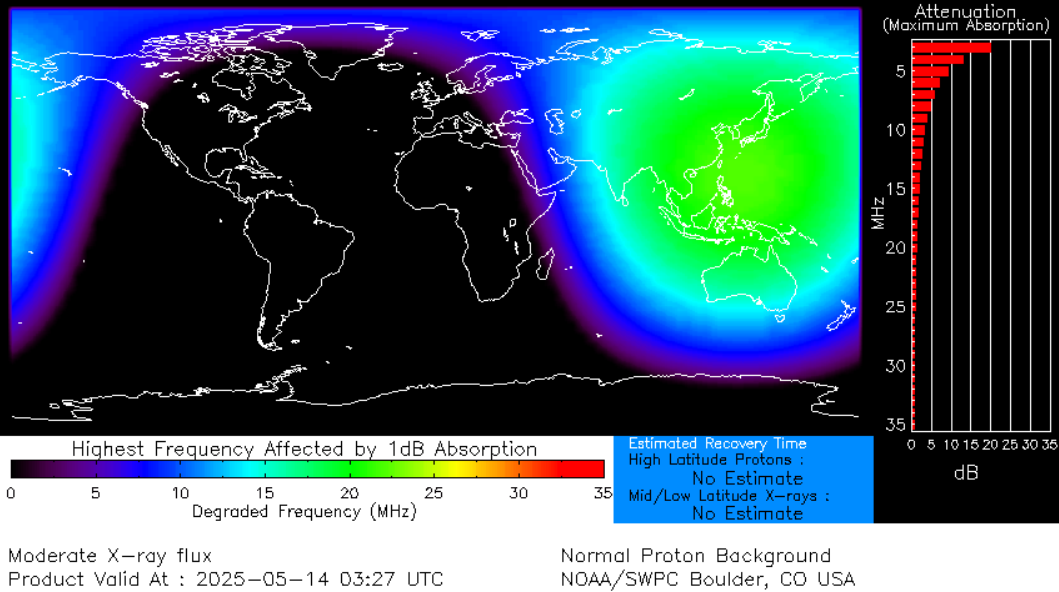
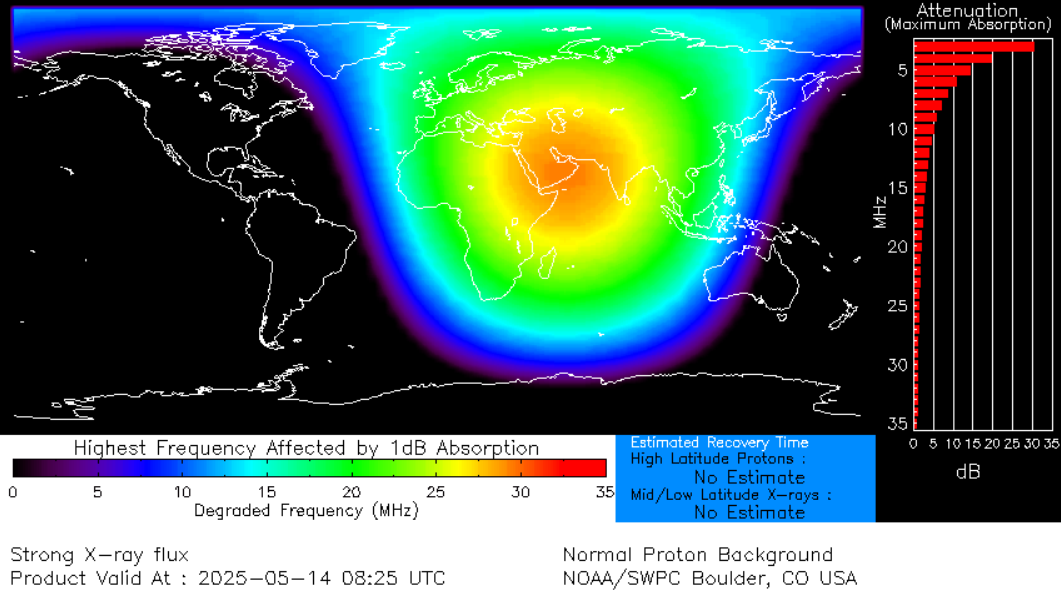
Radiation from the flares has caused a series of shortwave radio blackouts around the world--first over the Americas, followed by southeast Asia, the Middle East and Africa. Ham radio operators may have noticed unusual propagation effects from stations in all directions since May 13th.
Most of this activity has come
from new sunspot 4087, which emerged over the sun's northeastern limb 2
days ago. It is not yet facing Earth. If the explosions continue for a
few more days, however, Earth will find itself squarely in the strike
zone with geoeffective CMEs heading our way.
THE ELECTRIC FOREST--TREES RESPOND TO A SOLAR ECLIPSE: Solar
eclipses aren't just for homo sapiens. Researchers have long known that
birds, insects, and many other mammals pay attention when the Moon
slides in front of the sun. Now we can add trees to the list.
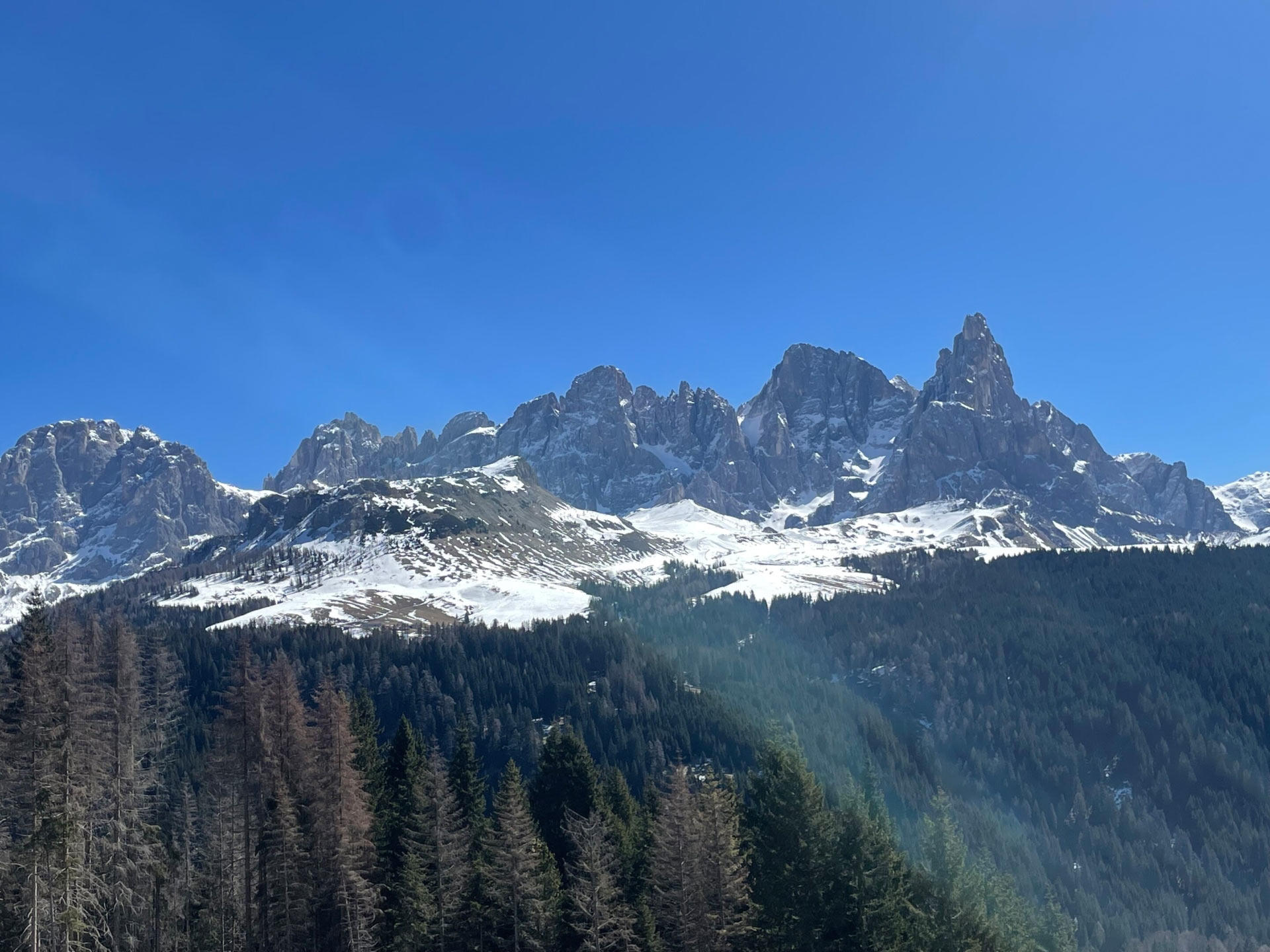
The study's location in the Dolomite Mountains of Italy. Photo credit: Monica Gagliano
A paper just published in the journal Royal Society Open Science
reports the extraordinary reaction of an Italian mountain forest to a
partial eclipse on Oct. 25, 2022. Electrical signals inside spruce
trees began to pulse in unison, with older trees seeming to
anticipate the eclipse before it happened.
This is unconventional research, and it may
challenge what some readers think about trees. However, it is serious
work conducted by experts in plant communication and published in a
peer-reviewed journal of the Royal Society.
The paper reports how scientists led
by Alessandro Chiolerio of the Italian Institute of Technology and
Monica Gagliano of Southern Cross University attached electrodes to
three Norway spruce trees and five tree stumps. Their device is
like an EKG for trees. The trees were different ages, ranging
from 20 to 70 years old, allowing the team to compare how age
might influence bioelectrical responsiveness to the eclipse.
Electrodes connected to the spruce trees during the eclipse. Photo credit: Monica Gagliano
As the eclipse approached, electrical
signals from different trees began to align; their waveforms
became more similar in shape and timing. This synchronization
peaked during the eclipse and gradually diminished afterward. The
older trees started showing electrical changes earlier, hours before
the eclipse began, while the youngest tree responded later and
more weakly. The tree stumps also exhibited a bioelectrical response,
albeit less pronounced than in the standing trees.
The researchers interpreted this as a coordinated "organism-like" response to a large-scale environmental event, possibly involving communication or shared signaling pathways.
The idea that trees may "talk" to one another is key to the burgeoning field of plant communication.
A growing body of research (especially since the 1990s) suggests that
trees form symbiotic relationships with fungi, creating vast
underground networks called the "Wood Wide Web." Through these
networks, trees exchange nutrients, water, and even chemical
signals. They also reportedly recognize their own young and give
preferential treatment to kin. Even tree stumps may retain connections
to this network.
"Basically, we are watching the famous 'Wood Wide Web' in action!" says Gagliano.
Although the researchers successfully
detected electrical activity in the trees, they have no idea what was
being said--if anything. Perhaps it was simply a basic response to
changes in temperature or light levels (about 1/3rd of the sun was
covered during the eclipse). The researchers don't yet speak the
"language" of arboreal electricity, so they can't decipher what they
overheard. Repeating the experiment in different forests during more
eclipses may be revealing.
Stay tuned for updates from the forest.
Recommended reading: Two good introductory books on plant communication and networking are "Finding the Mother Tree" by Suzanne Simard and "The Light Eaters" by Zoe Schlanger.
The Earth’s magnetic field protects us, and our orbiting tech, from the worst effects of the Sun’s energetic rays.
In a region called the South Atlantic Anomaly, however, the
magnetic field is significantly weaker than over the rest of the planet.
NASA is tracking the anomaly, and researchers believe it may have popped up in our sky before.
Earth’s
magnetic field is incredibly important to life on our planet. Beyond
allowing for compass navigation and displaying the Aurora Borealis way
up north, it is responsible for shielding us from the worst effects of
the Sun’s rays. A little bit of Sun, we need—a lot would have some
serious negative impacts.
Thankfully, we do have a magnetic field. But there’s a bit of a problem: Our magnetic field has a dent in it—what ScienceAlert calls a “pothole in space.”
It’s called the South Atlantic Anomaly
(SAA), and it’s not a physical dent. It’s a region in the skies between
South America and Africa where our magnetic field is weaker than it is
around the rest of the planet. This weakness isn’t life-threatening—it
would have to be way more significant to threaten the planet’s
surface—but it is an issue for the craft we’ve launched into orbit.
Objects like satellites
and other spacecraft reside within our magnetic field as they orbit the
Earth. As such, they still benefit from its protection. Take that away,
and you get a mess of potential technical difficulties—from small
glitches to data loss and serious damage of important components—caused
by too much exposure to high energy particles from the Sun.
It’s
enough of an issue that those monitoring spacecraft that pass through
the SAA often just power the craft down before they enter the region. As
such, NASA has been keeping a close eye on this dent for a number of
ears now, trying to figure out how it behaves, what’s causing it, and if
it’s a sign that things are about to get a lot worse.
The
SAA seems to be caused a huge reservoir of very dense rock deep
underground called the African Large Low Shear Velocity Province. The
biggest contributor to the creation of Earth’s magnetic field is the
movement of molten metal in the outer core
of our planet, and the African Large Low Shear Velocity Province
disrupts that flow, weakening the overall magnetic field as a result.
So
far, it at least seems like the region isn’t some kind harbinger of
doom—it doesn’t look like we’re losing our magnetic field any time soon.
But it could mean we have something to brace for. Some researchers
theorize that the SAA is an indication that the Earth’s magnetic field
is about to flip
(which can happen, though over the course of hundreds of thousands of
years), which would most likely have serious consequences for our
electronics and communications systems.
But
there’s still a lot we don’t understand about this anomaly, especially
regarding its behavior. For example, a study from 2016 discovered that
the SAA is drifting slowly northwest, and in 2020, it was announced that
researchers had discovered the region was splitting into two smaller
regions, each centered on an especially weak point.
Even
though we still have a lot of questions about SAA, we think we know one
thing: this isn’t the first time it’s popped up. In 2020, researchers
released a paper suggesting that the SAA just pops up every so often,
with occurrences dating back to 11 million years ago. This would
indicate we’re not, in fact, looking at the first signs of a flip at
all, but some other less-world-altering event that has happened many
times in the past. So, even though a dent like this may seem scary, it’s
probably something life on Earth has survived before.
NASA
will continue to monitor the SAA until we really and truly understand
the dent in our sky. Until then, we may just have to keep turning our
satellites off and turning them on again.



 The idea that trees may "talk" to one another is key to the burgeoning field of plant communication.
A growing body of research (especially since the 1990s) suggests that
trees form symbiotic relationships with fungi, creating vast
underground networks called the "Wood Wide Web." Through these
networks, trees exchange nutrients, water, and even chemical
signals. They also reportedly recognize their own young and give
preferential treatment to kin. Even tree stumps may retain connections
to this network.
The idea that trees may "talk" to one another is key to the burgeoning field of plant communication.
A growing body of research (especially since the 1990s) suggests that
trees form symbiotic relationships with fungi, creating vast
underground networks called the "Wood Wide Web." Through these
networks, trees exchange nutrients, water, and even chemical
signals. They also reportedly recognize their own young and give
preferential treatment to kin. Even tree stumps may retain connections
to this network.