Oldest Known Human Remains Extend our History Back by 100,000 Years - say what?


Adding to a recent string of discoveries that are rewriting the narrative of human evolution, fossils of a number of ancient human individuals that were unearthed in Morocco have been dated to more than 300,000 years ago. this find pushes evidence for the age of Homo sapiens back by roughly 100,000 years, and also shows that our ancient ancestors were much better traveled than previously assumed.

The fossils in question were excavated from the Jebel Irhoud cave, located 62 miles west of modern-day Marrakesh, and included the remains of five individuals, along with flint tools and the remains of their campfires. The skulls of the individuals bore faces that were unmistakably that of modern humans; although despite having a brain of similar size to other H. sapiens, the cranium was somewhat flattened and elongated towards the rear, unlike the more spherical braincase we see today.

The researchers were surprised to find that the group's tools dated to between 280,00 to 350,000 years ago -- roughly one-third older than modern humans were assumed to be. The previously oldest known remains were 200,000 years old, and found in Ethiopia, prompting the scientific community to assume that the area they were found in was the origin of humanity. But aside from being separated by 1,000 centuries, the remains found in Morocco and Ethiopia are on opposite sides of the African continent: with the far older remains being found 5,600 kilometers (3,500 miles) away from the previously-assumed eldest fossils, this raises the question of where modern humans actually originated from.

"What people, including myself, used to think was that there was a cradle of humankind in East Africa about 200,000 years ago, and all modern humans descend from that population," explains Philipp Gunz, with the Max Planck Institute for Evolutionary Anthropology. "The new finds indicate that Homo sapiens is much older and had already spread across all of Africa by 300,000 years ago. They really show that the African story of our species was more complex than what we used to think." 

Good Music Monday: Perfume Genius


BOOM!

 you needed this

My curious journey from orphan to activist

READ THIS
All humans–including orphans–should have a right to know and have access to our first family and to ancestral roots. The demand-driven adoption market ignores childrens’ rights.
Visit the website: http://www.adoptioncoalitionworldwide.com

Redbone: Message From a Drum


"Forget Winnetou!"

Sunday Love: Wilma Mankiller


Obit (2016)

I’ve hoped for another glimpse inside the minds of New York Times obituary writers. So when I heard about Vanessa Gould’s latest documentary, Obit, I rushed to see it. The film, one of the most endearing—and, perhaps surprisingly, uplifting—I’ve seen in awhile, follows the paper’s necrology department as they piece together the lives of the recently deceased: everyone from William P. Wilson, who not only negotiated the terms for the 1960 presidential debate but who also applied the makeup that gave Kennedy his “unflappably cool” look onscreen; to Betty James, the woman who thought up the name for her husband’s new toy—Slinky. The sweetest parts of the film, though, are the interviews with the writers themselves—Bruce Weber, William Grimes, and Fox, among others—all of whom take seriously the task of celebrating their subjects, breathing life and humor into their work. As Fox tells us, “Obits have next to nothing to do with death and absolutely everything to do with life.” The same is true of Gould’s remarkable film. —Caitlin Youngquist  via

Friday's are all about art

Some two dozen performers took over the building’s public garden on June 14 to protest President Trump’s plan to eliminate the NEA. Read More →

friday.look here.

Who knew that Georgia O’Keeffe made war paintings? She steals the show with a small and very moving watercolor, “The Flag,” of 1918. It depicts an all-red flag fluttering against a navy-blue sky and looks like an object that is bleeding to death. O’Keeffe’s kid brother, Alexis, served in the war, and she once said that her goal was to paint a flag “trembling in the wind like my lips when I’m about to cry.”
LISTEN: Review: Uncle Sam Wants You (To Look at Art)! - WNYC News - WNYC

hello it's me

this song is like a flashback for me... many reasons... even a boyfriend... BOOM!

Appreciation Friday: Carlo Zinelli

Carlo Zinelli, Untitled, made in the San Giacomo Hospital, Verona, Italy (1961). (Photo by Henri Germond/copyright Fondazione Culturale Carlo Zinelli)

Carlo Zinelli (1916-74) at the American Folk Art Museum (until 20 August) is the first US solo show of this self-taught Italian artist who had a breakdown after his time fighting in the Spanish Civil War. In 1947, having lost his ability to communicate verbally, he permanently entered a psychiatric hospital in Verona. There, he took up drawing in 1955 and painting two years later. The exhibition presents 55 of his compelling works in tempera that often feature frenetic, repeating motifs of human or animal figures in bright colours. Many of the works were painted on both sides of the paper, and presented recto and verso in the show.
VIA NYC

Emotional Interview with Robert Downey Jr.

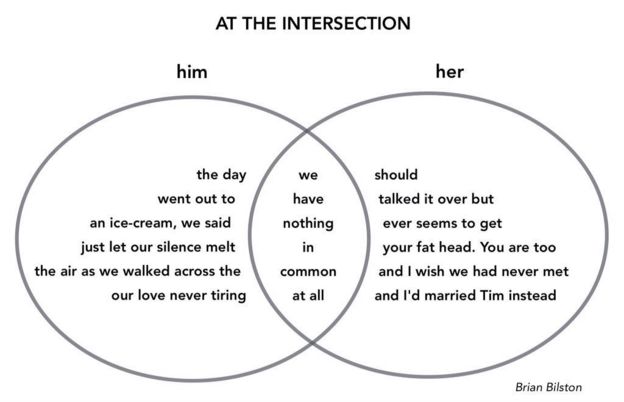
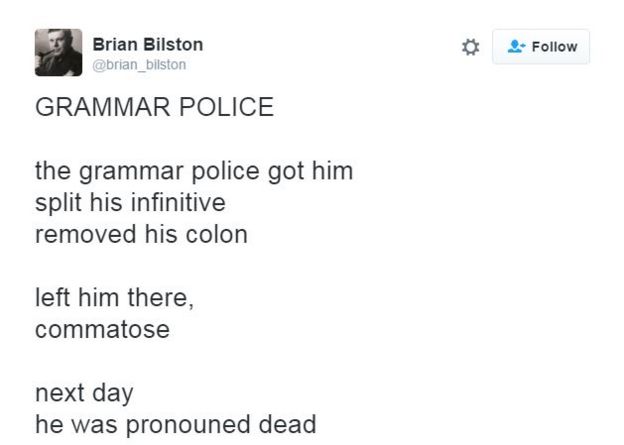
Twitter Poet Laureate Brian Bilston

READ

excerpt:
But (twitter) is also a platform for poets themselves to interact and engage with their audience - and, indeed, find new audiences - through experimentation with content and form, and a deeper engagement with real world concerns.
I shall finish with one more poem, written one day when Twitter became unavailable for a whole afternoon, much to the angst of millions of people around the world.

It's called The day that Twitter went down.

That day I got things done.
I went for a long run.
Played ping-pong,
Wrote a song.
It got to number one.
That day I did a lot.
I tied a Windsor knot.
Helped the poor,
Stopped a war,
Read all of Walter Scott.
O what a day to seize.
I learnt some Cantonese.
Led a coup,
Climbed K2,
Cured a tropical disease.
That day I met deadlines,
Got crowned King of Liechtenstein,
Stroked a toucan,
Found Lord Lucan,
Then Twitter came back online.

Thursday Thought: Visionary Hildegard

"We cannot live in a world that is not our own, in a world that is interpreted for us by others. An interpreted world is not a home. Part of the terror is to take back our own listening, to use our own voice, to see our own light." - Hildegard von Bingen (who was a mystic and had visions)

Hildegard of Bingen, O.S.B., also known as Saint Hildegard and Sibyl of the Rhine, was a German Benedictine abbess, writer, composer, philosopher, Christian mystic, visionary, and polymath. More at Wikipedia 
Beginning in early childhood Hildegard of Bingen experienced visions she couldn’t adequately explain to others. Her visions didn’t come through her eyes and ears. They were experiences of sight and sound seen through her inner senses.  As a result, they were visions she kept to herself for many years.
At the age of 42, Hildegard experienced a midlife awakening. She received a vision, wherein she believed God had instructed her to write down what she saw. She was hesitant to do so, at first. She spoke of this milestone experience in her first work, Scivias. Scivias is both prophetic and admonishing in the manner of Ezekiel and the Book of Revelation. It also famously describes the structure of the universe as an egg. MORE


hildegard of bingen was 3
“Everything that is in the heavens, on earth, and under the earth is penetrated with connectedness, penetrated with relatedness”
– Hildegard of Bingen

The Lakota say Mitakuye Oyasin which means WE ARE ALL RELATED, and relatives.


just a reminder

  good reminders!  


oh yeah...

oh yeah...

Trace's book